Qipao, Heirloom Garments & Cultural Details
Some garments are not garments first. They are a photograph, a person, a memory that cannot quite be told in full. This branch is about letting such a piece be worn again, after its memory has been respected.
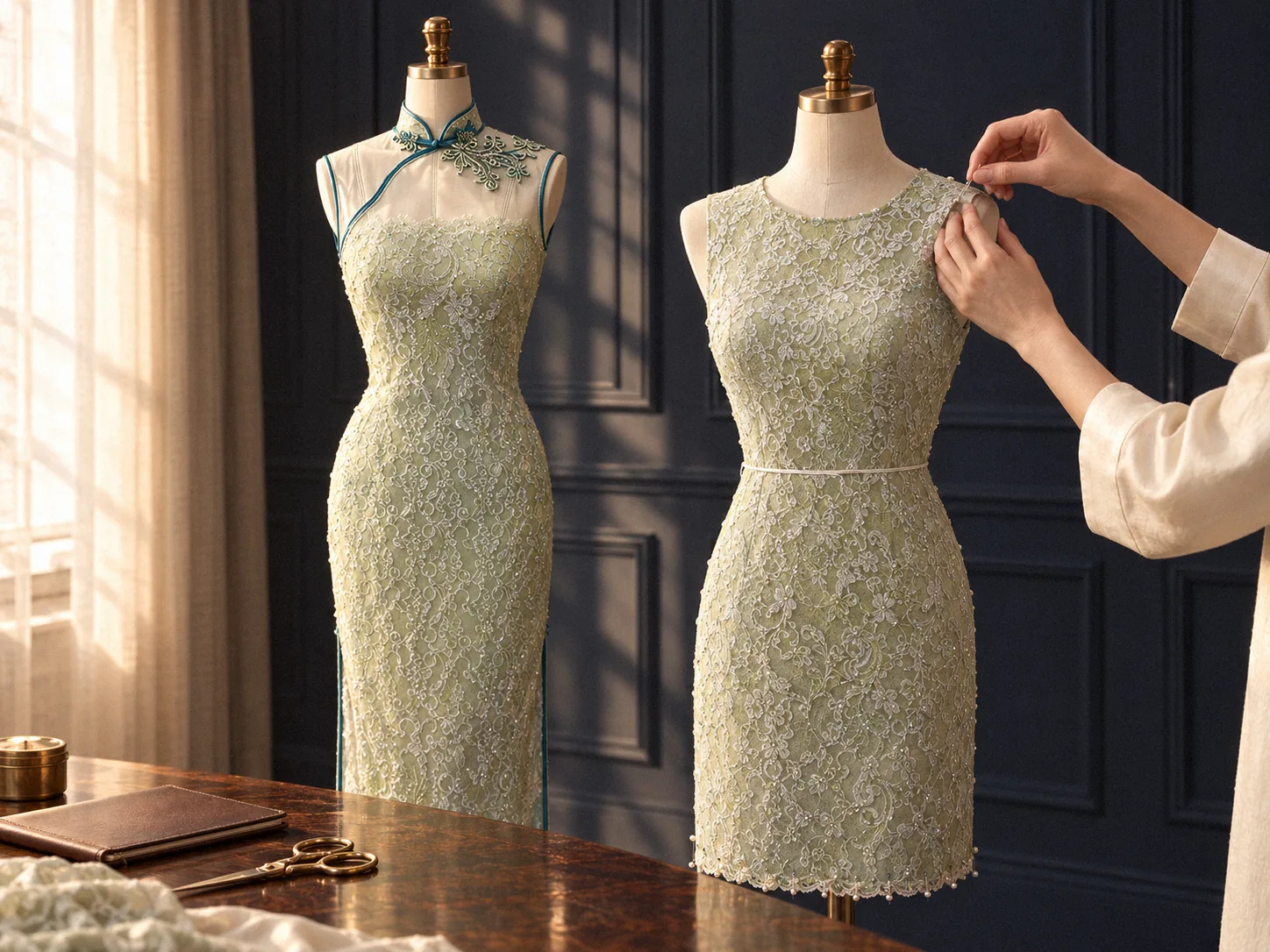
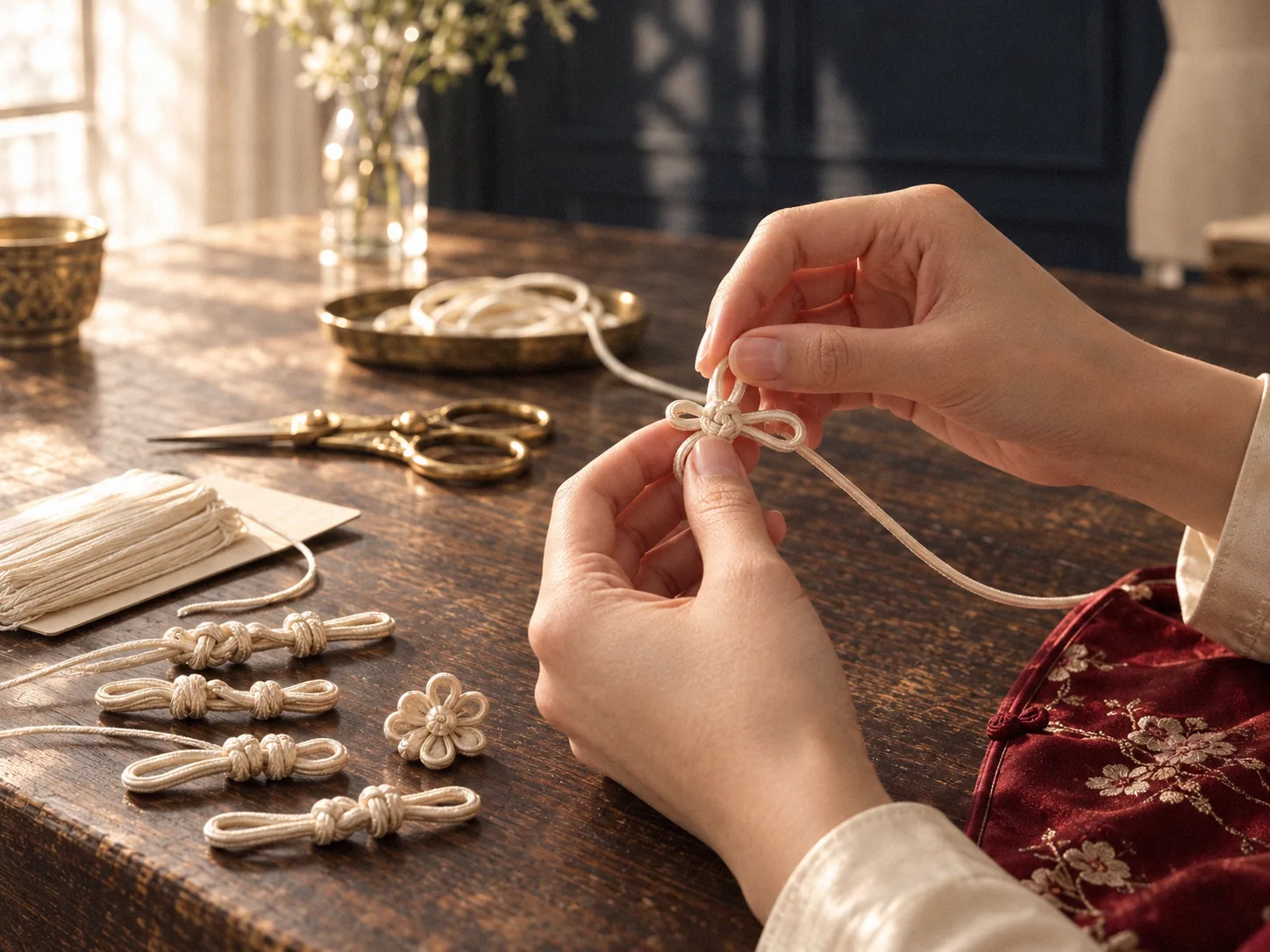
24 knowledge cards in this branch
Each card answers one question clients often ask: a direct answer first, then the judgement behind it. Open a card by its title; every card has its own link, so you can share it with a friend or family member.
Cards are the short form of the guides. If your garment is in a more complex state, read the related guide first, then book an assessment.
E182How do we read the structure of a qipao?
The collar sets the visual height, the slits govern movement and the hem line, and the piping carries the strain along every edge. These three balance against the fit built by the side seams, centre back and bust curve.
Lower the collar and the bust allowance or interfacing must be reworked. Changing the slits depends on the hem width and the fabric's give. A new piping material hardens or softens the whole outline. Every single adjustment shows at the other seams, and the exact range is measured on the garment.
Link to this card · E182E184What matters with piping and knotted buttons?
Piping holds the curve and strain of the edge; the position of the knotted buttons decides how the fronts meet and where strain travels. Both are assessed with the whole line before any change.
A different piping width changes the radius of the edge and how the bust and cuffs fall. Moving a button even slightly may require adjusting the seam inside. We measure the original piping width and stitch length first and check whether the buttons are backed. The room to move is limited by allowance, pattern symmetry and the single-piece cut.
Link to this card · E184E185How is the length of a qipao adjusted?
Length decides how the hem moves and how you walk. Shortening means re-setting the slits; lengthening depends on the hem allowance and seams. The right length is set at a fitting.
Trimming the hem without moving the slits restricts the stride and looks wrong. Lengthening needs a turned allowance or kept cloth; otherwise matching fabric is added, with care over the join and pattern continuity. Motifs and embroidery limit where cuts can fall.
Link to this card · E185E186How are sleeve length and shoulder line altered?
Sleeve length is set from the shoulder line. For more movement, we look first for room in the armhole or shoulder allowance rather than only changing the sleeve.
A small shift at the shoulder changes where the bust sits and how the sleeve reads. With enough allowance the armhole can be opened while keeping proportion; without it, the shoulder or centre back must be adjusted as a whole. Shortening the sleeve alters how the cuff piping turns. Shoulders and armholes pull on the back and bust structure, so the range is set at a fitting.
Link to this card · E186E187What if a qipao no longer fits?
We first measure the allowance at the side seams, centre back and bust. Where it is limited or the cloth fragile, letting out usually means inserts or recutting; taking in is more direct, but the bust curve and armhole must be re-set.
On a precious satin with no matching cloth, letting out raises problems of material and visual join. Where the body has changed greatly, we may suggest keeping the valued elements and transforming the piece into a top or stole. What is possible depends on the original cloth, allowance and pattern matching, measured on the garment.
Link to this card · E187E189What is the first step with an heirloom garment?
Slow down. Photograph front and back, note where the damage is, write down the memories attached to it, make a basic structural check, then store it properly and wait for a professional assessment. Do not rush to clean or cut.
Check the allowances, whether the lining has lifted, whether needle holes have enlarged or dye has bled. Store flat or rolled gently along the seams, and avoid cleaning; the wrong cleaning makes later repair harder. Seek a studio that works in layers and records each step, keeping reversible repair possible.
Link to this card · E189E190Preserve as it is, or redesign?
Set the goal, from preservation through local repair to full transformation, by emotional priority, the state of fabric and structure, and future use. Emotional elements such as buttons and embroidery are marked untouchable first.
Fragile fabric or faded dye limits recutting and frequent wear, and display or an accessory may be the better path. When redesigning, the most representative details are carried into the new garment in a removable or transferable way. Each option comes with its own care and cleaning plan.
Link to this card · E190E191How is a wedding qipao assessed?
Book a fitting and bring notes on the bridal styling and the movements of the day. Adjustments are led by range of movement and how the beadwork bears it, in the intended underpinnings and heels.
We check the fit at bust, waist and hip and the pull when seated, and whether the collar allows breathing and the tea ceremony. Sequins and embroidery are tested in movement for risk of loss, with backing where needed. The order is comfort in motion, proportion, safety. On aged fabric or heavy hand beading, reinforcement and resizing are decided on the garment.
Link to this card · E191E192How are vintage Chinese garments handled?
First the integrity of the fibre and the age of the thread; then preserving cultural traces and structural safety. Where the structure is weak, backing, spreading the strain and protective panels come before unpicking original seams.
Touch and a loupe reveal thinning, breaks and staining; where dye migrates, cleaning is conservative. Patches and stains may be history, which affects whether to restore fully. Decisions rest on preserving the original, strengthening the structure and, if it is to be worn, assessing sweat and abrasion. Where fibre has failed widely, wearability is tested in person.
Link to this card · E192E193What should I know about silk qipao?
Silk is highly sensitive to how tightly it is stitched. Adjusting the waist needs ease and reinforced seam ends, fine needle and thread, evenly spaced hand stitches and, where needed, a light interlining to take the strain. Never pull it hard.
When re-piecing patterned satin or silk twill, the light direction and pattern continuity matter. Press at low heat through a dry cloth. Holes are stabilised with fine net behind before invisible stitching in matched silk. Larger changes need trial piecing and stitching on the garment, or the result may read unevenly or tear at the seams.
Link to this card · E193E194How is a lace qipao handled?
The continuity of the lace pattern and the strength of the net limit major cutting. For resizing or restyling we piece symmetrically or lift whole motifs and re-set them, reinforcing the net's load points with fine net or interlining behind.
Beading adds local weight, and its pull on the net is assessed; beads may be removed and re-sewn onto reinforced backing. Joins are hand-sewn and hidden, avoiding machine lines across the pattern. Where lace is brittle in places or heavily beaded, whether it can be opened and re-set is confirmed on the garment.
Link to this card · E194E195How are qipao elements carried into a new garment?
A collar, knotted buttons, a motif or an embroidered edge with intact edges and sound allowance can be cut as a unit and sewn into a new pattern. Motifs near fragile cloth are backed before they are cut away.
Setting a qipao collar into a jacket means checking the collar stand's thickness and the shoulder drop. Buttons and beads are re-sewn with a hidden backing. Where the original cannot be opened safely, reproduction replaces direct re-use. Where thickness or strain differs greatly, a trial fitting confirms the join will not harm the original.
Link to this card · E195E196How should a qipao be hung and stored?
Use a wide, curved hanger to support the shoulders, cushion beaded areas with tissue, and cover with a breathable cloth bag for the short term. For long-term storage, lay flat in acid-free tissue in a box, away from damp and direct sun.
Garments without a shoulder seam go onto the hanger through the body, never by pulling the collar. Fold gently along natural seams to avoid sharp creases. Avoid sealed plastic covers, which trap moisture. Heavily beaded or fragile silk qipao should not hang for long.
Link to this card · E196E198How much time should a qipao alteration for an occasion allow?
Simple resizing or sleeve adjustments take less time; work involving recutting, re-piecing motifs or hand reinforcement needs several fittings and trials. Vintage or fragile qipao should be booked earlier still.
For weddings and ceremonies, align the schedule with the stylist so that underpinnings, hair and heels match at the final fitting. Where hand unpicking, re-sewing or colour matching is involved, the time and feasibility are assessed on the garment.
Link to this card · E198E199How do I book a first qipao assessment?
Bring the underpinnings and heels you intend to wear, and any history or record of earlier alterations. Photographs of the full look, or notes on the day's movements, make the assessment more precise.
Waist position and length change with heel height. Occasions that involve sitting, kneeling or stepping on stage affect whether the slits are eased or the bust reinforced. A first assessment identifies the main risks and options quickly; feasibility and cost are confirmed only after examination and a small trial.
Link to this card · E199E202How are the side seams and ease of movement adjusted?
Usually the side seams are let out by one to three centimetres, depending on allowance and give, and if that is not enough the slits are raised by one or two. A smoother lining also makes a marked difference.
Lining friction is the most overlooked factor. Letting out and raising the slits must keep the waist-to-hip ratio and the side curve; too much changes the original silhouette, and care is needed on qipao of age. We model the line first, then confirm with temporary stitching at a fitting. On qipao with original piecing or historic seams, over-easing can damage the cut.
Link to this card · E202E203How are period patterns matched at seams?
The main motif comes first; a flower centre or leaf vein becomes the matching reference, panel edges are adjusted so the principal petals or emblems sit on the face, and secondary patterns fall at the seam.
Symmetry matters most at the centre line and bust. Where a seam must cross the main motif, matching thread and fine stitching make it visually acceptable. Repeating patterns can be pieced to save cloth, with backing at the join for flatness. Where cloth is limited, the principle is to keep the main motif and soften the seam.
Link to this card · E203E204How is the cost of remaking buttons and piping judged?
Cost comes from materials, handwork and scope. Hand piping takes longer at curves, cuffs and collars; reproducing buttons one by one costs more. Re-sewing original buttons rather than replacing them reduces the cost considerably.
We first assess locally without opening the body, such as matching one button or trialling piping on a short edge, and proceed only when satisfied. On older garments the balance between restoration and alteration matters, and keeping the original usually serves its value best. A detailed estimate follows an in-person examination.
Link to this card · E204E205Can Chinese embroidery be transplanted or preserved?
Yes, within the limits of base damage, faded thread and reconstructed stitching. Where thread is firm and the base sound, the embroidery can be lifted along its working line; where the base is fragile, the outline is taken and the motif reworked in the original stitches on new cloth.
Fixing methods include sheer net behind the embroidery, invisible hand stitching onto the new base, and allowance at the join to spread strain. Reproduction threads are matched against the original before use. Where thread has gone brittle or the base has split, lifting may cause irreversible damage and is decided under magnification.
Link to this card · E205E206Can a qipao collar be modernised?
Yes, with a reinforced collar interfacing, a reworked placket and attention to the original seams and motifs. A traditional mandarin collar holds its shape with stiff interfacing; lowering or opening it means rebuilding both the interfacing and the placket.
A lower or V neckline usually means adjusting the shoulder and bust proportions too. A light interfacing forms the new collar, with hidden reinforcing tape inside. We work progressively: a sample tests the depth before the full change. Where the original collar carries embroidery, buttons or seams close to its edge, the range is limited.
Link to this card · E206E207How is thin silk or aged cloth repaired with minimal intervention?
First relieve the strain around the damage, then apply sheer net behind to spread the load, or a very thin matched patch, fixed with extremely fine silk thread in running or invisible stitches. Stitch spacing is just enough to support the weave.
Long tears or holes near an edge are handled with a small panel and adjusted lining support, avoiding a large surface patch. A miniature sample is made first, then the least necessary work done on the original. Where preservation matters most, backing alone may be used without a visible patch. Powdered silk or unstable dye must be assessed in person before any repair.
Link to this card · E207E208How are colour and hand chosen for a new qipao lining?
Slip and show-through come first. Light or sheer outer cloth takes a lining near its own colour or a skin tone; the material is a smooth viscose, fine cotton sateen or light silk, with attention to how its weight affects the outline.
Too heavy a lining changes the outer drape; too light fails to spread the strain at the seams. Embroidered or buttoned areas need a reinforcing patch. We first try a small piece at the bust and cuff to judge show-through and fall, then replace the whole. Where the outer dye is unstable or has a particular sheen, a local trial comes first.
Link to this card · E208E209How can qipao elements enter everyday clothes?
Identify the most recognisable elements: the collar, the knotted buttons, the piping and particular motifs. A whole collar can become the neckline of a jacket or shirt; buttons and piping can detail cuffs, belts or slits; embroidery and patterned cloth can form pockets, brooches or be pieced into a gilet or stole.
Re-using cloth depends on the size and grain of each piece. Original seam marks or patches can be kept visible in the new design to preserve the garment's history. We test on paper first, then open the original only where needed. Fragile material is stabilised with backing before cutting.
Link to this card · E209E210Can a qipao be locally reinforced to extend its life?
Yes. The underarm and shoulders wear from friction and pull, and are backed with interfacing or fibre net to spread the strain; splits at the slits are reinforced inside with a fine patch and stop-stitched along the tear.
Support materials are chosen to match the original's colour and give; where no trace is wanted, the backing is fixed with the finest thread. Very weak areas are stabilised locally before patching. We test the backing on similar cloth and trial a short invisible seam before reinforcing fully. Where structural damage is widespread or the fibre has powdered, local reinforcement may not be enough.
Link to this card · E210Thinking of a particular piece? Bring it, and we will read it together.
Back to the encyclopaedia