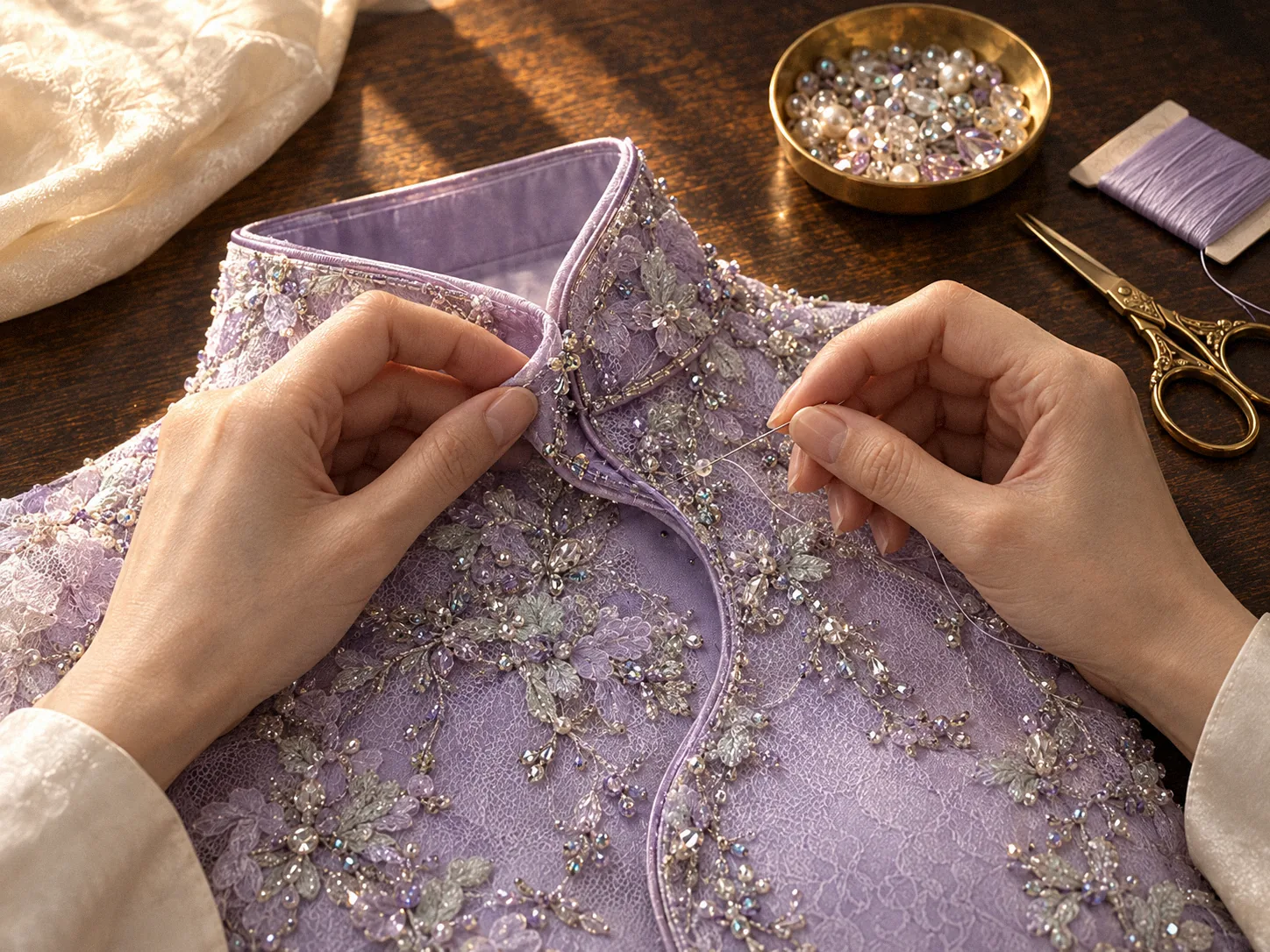
Beadwork is the qipao's light, and its weight
A fully beaded qipao glows under the lights. Hold it, though, and you feel at once what that glow weighs. On a densely beaded qipao, the beads can weigh several times the fabric itself, and all of it hangs on thread as fine as hair and a single layer of silk.
So the trouble with a beaded qipao is rarely the beads themselves. Most often it is the thread that has aged, or the cloth beneath that can no longer hold.
To keep the beadwork, what truly needs protecting is the invisible layer beneath it.
Step one: how the beads are fixed
Turn the qipao inside out and follow the thread paths. Threaded beadwork runs in a continuous line through the base, knotted every few beads; it lasts best, but thread ages, and forty-year-old silk thread snaps at a touch. Glued beads show no thread inside, only traces of adhesive; cleaned or warmed, they fall away in patches. Tacked beads are each sewn with a single stitch; losing one does not take others with it, but the number of needle holes is greatest.
Knowing the fixing tells us the path of repair: re-thread and re-sew, back and re-sew, or transplant the whole section.
Step two: does the base cloth still have strength
I lift the densely beaded area gently on my fingers and look at the base from inside. Healthy silk is taut and carries the beads evenly; tired silk shows tiny puckers and pulls between beads, needle holes that have gone shiny or white, even small splits. This is the cloth saying it can no longer hold.
At this point simply re-sewing beads is meaningless. A compatible backing must first go in from inside, spreading the weight over a wider area, and only then are the beads sewn back. The backing is chosen with care: too heavy and the qipao's drape changes; too light and it spreads nothing. Most often I use a featherweight silk organza or fine net.
Step three: keep the original arrangement first
The arrangement of beads is part of the design and often a piece of history. The person who sat under a lamp forty years ago sewing them on one by one left her hand in the direction of these beads. So before repair I photograph each area's layout and density, bag the removed beads by position, and follow the original rhythm when sewing them back.
Where an alteration requires beads to move, say a waist reduction crossing beaded side seams, I transplant that passage as a whole, with removable stitching, onto reinforced cloth and set it back in place. If the qipao must be altered again later, the beads can come out once more without harming the base.
The honest options when beadwork is too far gone
On some qipao most of the beads are gone and the base has grown brittle. Sewing every bead back would hang the weight once more on cloth that cannot bear it. I suggest two other paths: re-setting part of the pattern, gathering the remaining beads onto the areas where the base is still sound to form a smaller but complete motif; or lifting the finest passage of beadwork and making it into a brooch, a collar or a small bag, so the detail survives in another form.
After repair: cleaning and care
A beaded qipao should never be machine-washed, nor hung for long. Heavily beaded areas are cushioned with tissue and the garment stored flat. Tell the cleaner how the beads are fixed; glued beads in particular must avoid solvents and heat. I write this down at every hand-over, because the life of a repair is half in the studio and half in the wardrobe.
Where the studio draws the line
Whether beadwork can be kept, and how well, is bounded by the thickness of the base, the wear at the needle holes and the original stitching. An accurate judgement requires examining the underside and lining in person. We do not promise that beadwork can be kept as it is before we have seen the inside.