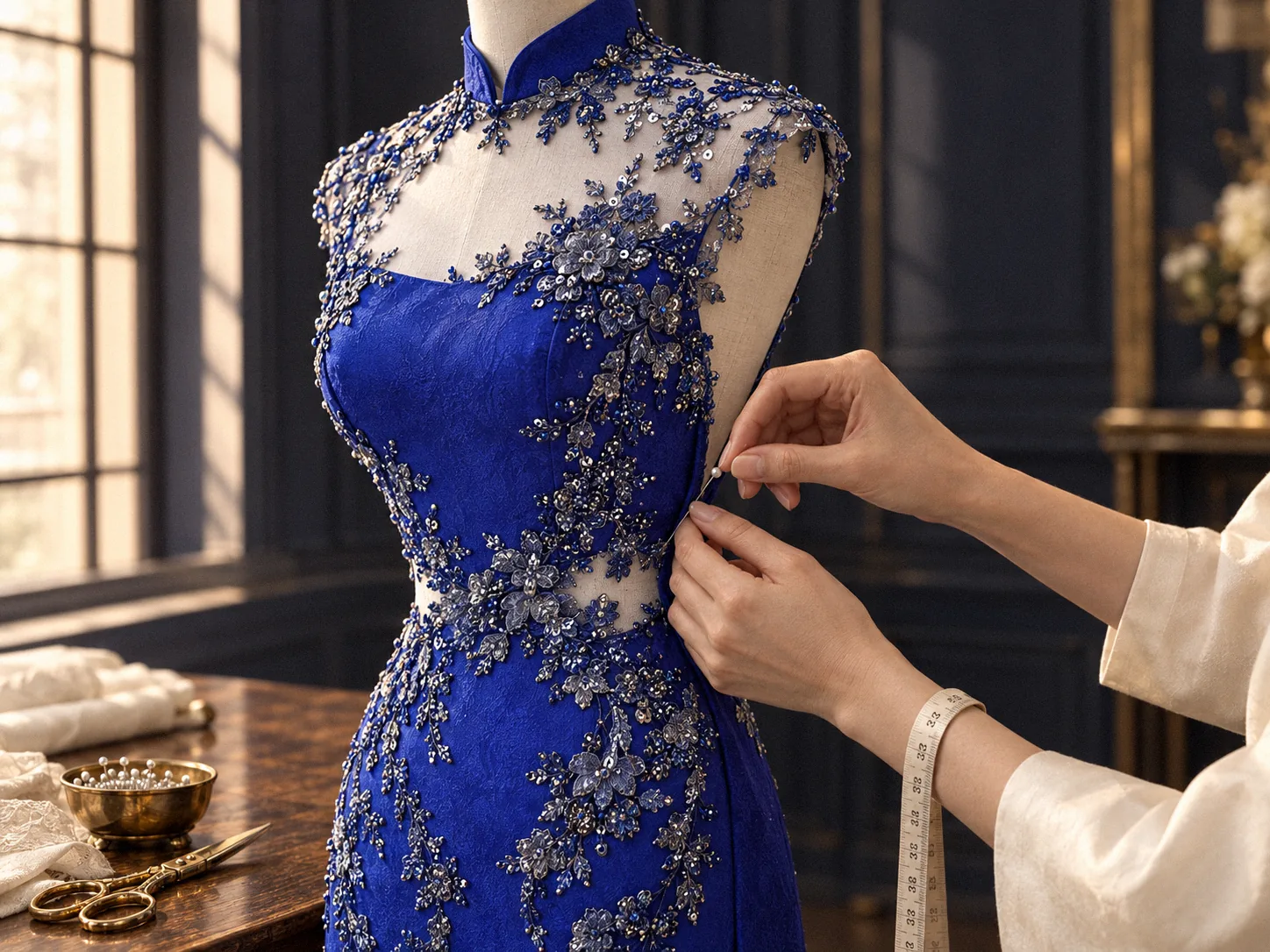
Why a qipao is unlike other garments
On a skirt, taking in the waist and shortening the hem are two separate jobs. On a qipao they are not.
A qipao is cut in one continuous line from neck to knee, following the body. Take in the waist by a centimetre and the curve at the hip must follow; move the curve across the bust and the collar height and button positions shift; shorten the hem and the slit is no longer in the proportion it was designed for. There is no “local” on a qipao, only the whole.
So the first step in altering a qipao is not to measure. It is to read the whole garment.
The static check: what the fabric is telling you
I lay the qipao flat and look at the fabric first. Brocade, crêpe satin, gambiered silk, velvet, lace: each answers the needle and the iron differently. Then the face and the reverse: any area of uneven sheen may have been repaired or rubbed. Then the direction of the dye: jacquards and prints have a direction, and panels cannot be turned when altered. Finally, traces of earlier work: old needle holes, old creases, allowance that has been trimmed. These are the previous tailor's notes.
Seam allowance: the qipao's most precious resource
How much a qipao can be let out is written entirely in its seam allowances. Side seams, shoulder seams, the bust curve, the centre back: I measure each. Traditional hand-made qipao often carry generous allowances, sometimes two or three centimetres, a gift from the old master to the future. Recent ready-made qipao often have a centimetre or less, and the room to let out is small.
Taking in is easier than letting out, but not without limits. Take in too much and the bust curve and armhole must be re-set, or the arm will pull when raised. Where allowance is lacking and the qipao must be let out, a side insert is considered, and whether that insert can match the pattern and sheen of the fabric is another question only the garment can answer.
Lining and seams
Turn the qipao inside out and see how the lining is cut. On some, lining and face are cut and sewn as one, so altering one layer means altering both; on others the lining is separate with its own allowance. Where the lining keeps spare allowance, waist and hip adjustments go more smoothly. The slip of the lining also matters: much of what feels like “poor fit” is a lining that drags, holding the face fabric back when you sit.
The five load points
The collar sets the visual height and the line at the neck; lowering or opening a mandarin collar means rebuilding its interfacing and the front placket. The slits govern movement and the hem line; when the length changes, their proportion must change with it. The piping is the load-bearing band along every edge, not merely decoration; change its material or width and the whole outline hardens or softens. The knotted buttons are the anchor points; their position decides how the fronts meet and where the strain travels, and moving one may mean adjusting the seam inside. The underarm is where a qipao most often splits, because every lift of the arm pulls on that small piece of cloth.
Any change at one of these points must be thought through at the other four. That is the greatest difference between altering a qipao and altering anything else.
The structure you cannot see
Last, I look at what cannot be seen from outside: tucks, shoulder pads, darts, the hidden pleats across the bust. Some qipao use fusible interfacing or particular stitches to reinforce these places, and once opened they are hard to restore. Where I find such structure, the range of possible changes narrows, and I say so plainly at the assessment.
Where the studio draws the line
Photographs give only a first impression of fabric and wear. Allowance, lining and hidden repairs must be confirmed by opening the garment or at a fitting. After the fitting and measurements, we set out in one go how much can change, which parts must move together, and what we would advise leaving alone.