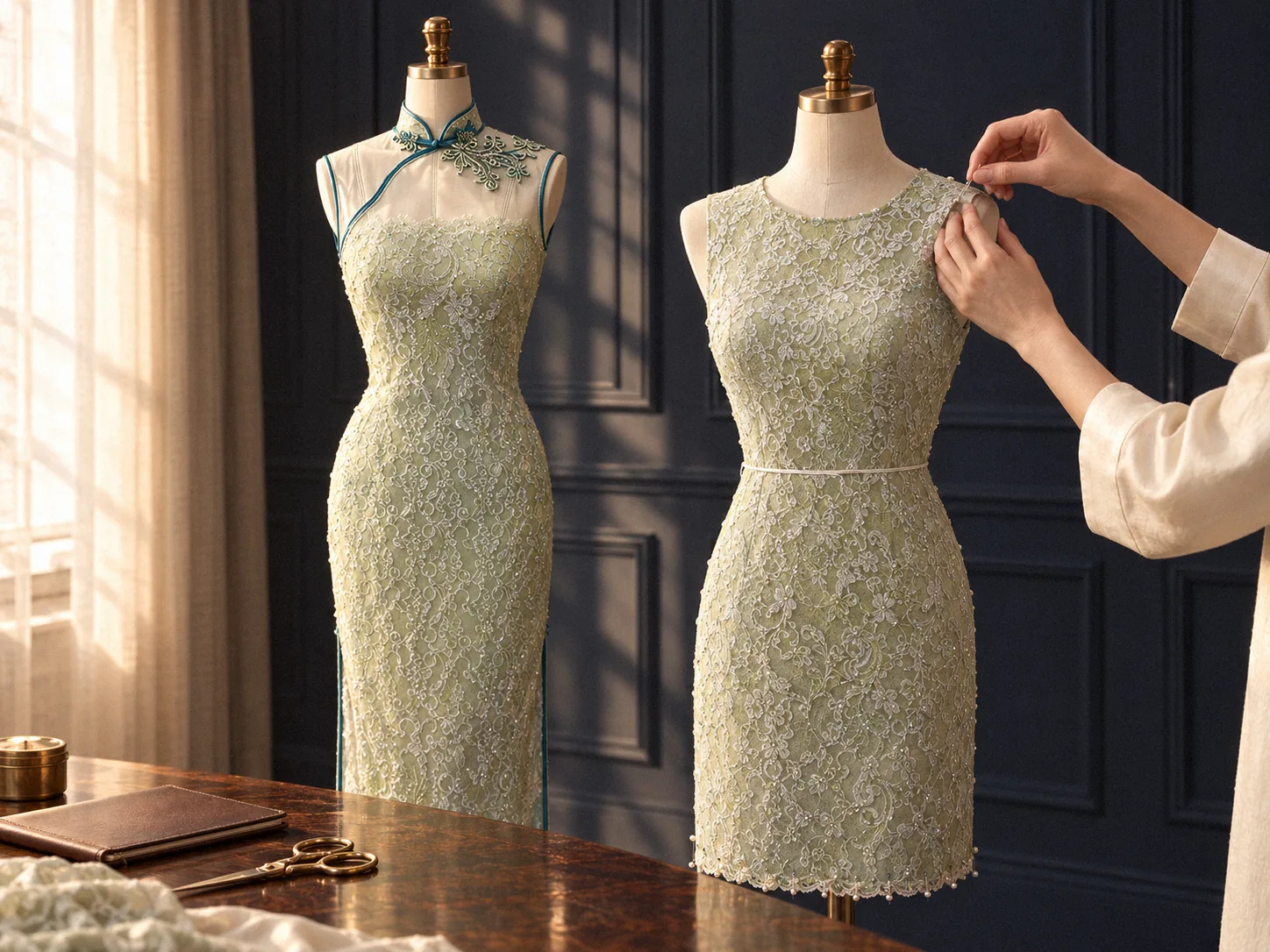
Why we ask before restyling a qipao
A client once brought a deep red brocade qipao to be made into a short jacket for everyday wear. She was certain how she wanted it. But when I turned back the front and found a small double-happiness character embroidered inside in red thread, I stopped.
It was the qipao her mother had married in, and the character had been sewn by her grandmother. She had not known. Had we cut as planned, the character would have gone.
Many details on a qipao carry a layer of meaning beyond design. Miss it, and you may cut away a family's memory without ever knowing.
Which details deserve particular care
Colour itself has meaning: bright red for weddings; certain purples, golds and blues tied to age, status or regional custom. Motifs speak: dragon and phoenix, peony, pomegranate, bat, ruyi cloud, each a blessing in itself. Embroidered characters are the most direct: happiness, longevity, fortune, or a name, or a date. The number and shape of the knotted buttons can matter too: straight knots, pipa knots, flower knots, each favoured in different periods and occasions. And there are private family marks: a coloured thread inside the collar, a small patch inside the hem, one bead in a particular place.
I cannot know all of them, so I ask. At the assessment I point out every detail that seems to be more than decoration and ask the owner to tell me where each one came from.
Three questions that set the scope
First, the owner's intention: does she want something to wear every day, something for particular occasions, or simply for the qipao to remain near her in another form? Second, whether the symbolic marks can survive being opened: is the cloth beneath the embroidered character still sound, is the button base reinforced, will removal damage anything? Third, the purpose: daily wear means sweat, friction and cleaning, all of which consume old fabric and old thread; ceremonial wear once a year makes entirely different demands.
For everyday wear: reproduce the symbol, protect the original
If the owner wants daily wear, I usually suggest bringing the symbolic elements into the new garment by reproduction or in miniature. The double-happiness character can be embroidered again in the same red silk inside the new jacket; the original piece of cloth is lifted with care, wrapped in acid-free tissue and returned. The new garment carries the meaning, and the original is not worn away in daily life.
If the knotted buttons are still sound they can move directly to the new garment; if fragile, a new set is made to match and the originals kept. This serves both ends, but it needs the owner's agreement, because it changes what “the original” means.
For ceremonial wear: keep the original, do only what is necessary
If the qipao is for a wedding, an ancestral rite or another ceremony, I keep the original structure and appearance. Only the necessary reinforcement, such as backing inside the underarm and slits; only the necessary cleaning, tested first in an unseen place. If the size truly does not fit, adjustments go into the seam allowances inside, touching no visible detail. In these cases, “not altering” is often the best alteration.
When two wishes conflict
Sometimes the family wants the original kept whole while the owner wants to wear it daily. On a single garment, both may not be possible. I do not choose for her. I set out where each path leads, its risks and what cannot be undone, and let her decide after seeing the garment and, perhaps, speaking with her family. There is no hurry. The garment has waited decades; it can wait a few more weeks.
Where the studio draws the line
Some culturally sensitive material and family taboos can only be explained by the owner; the studio cannot judge them on her behalf. Where a family wants the original kept whole and also worn daily, both may not be achievable; whether to reproduce or preserve is the owner's decision after seeing the garment. We proceed only once this has been discussed in person and agreed.