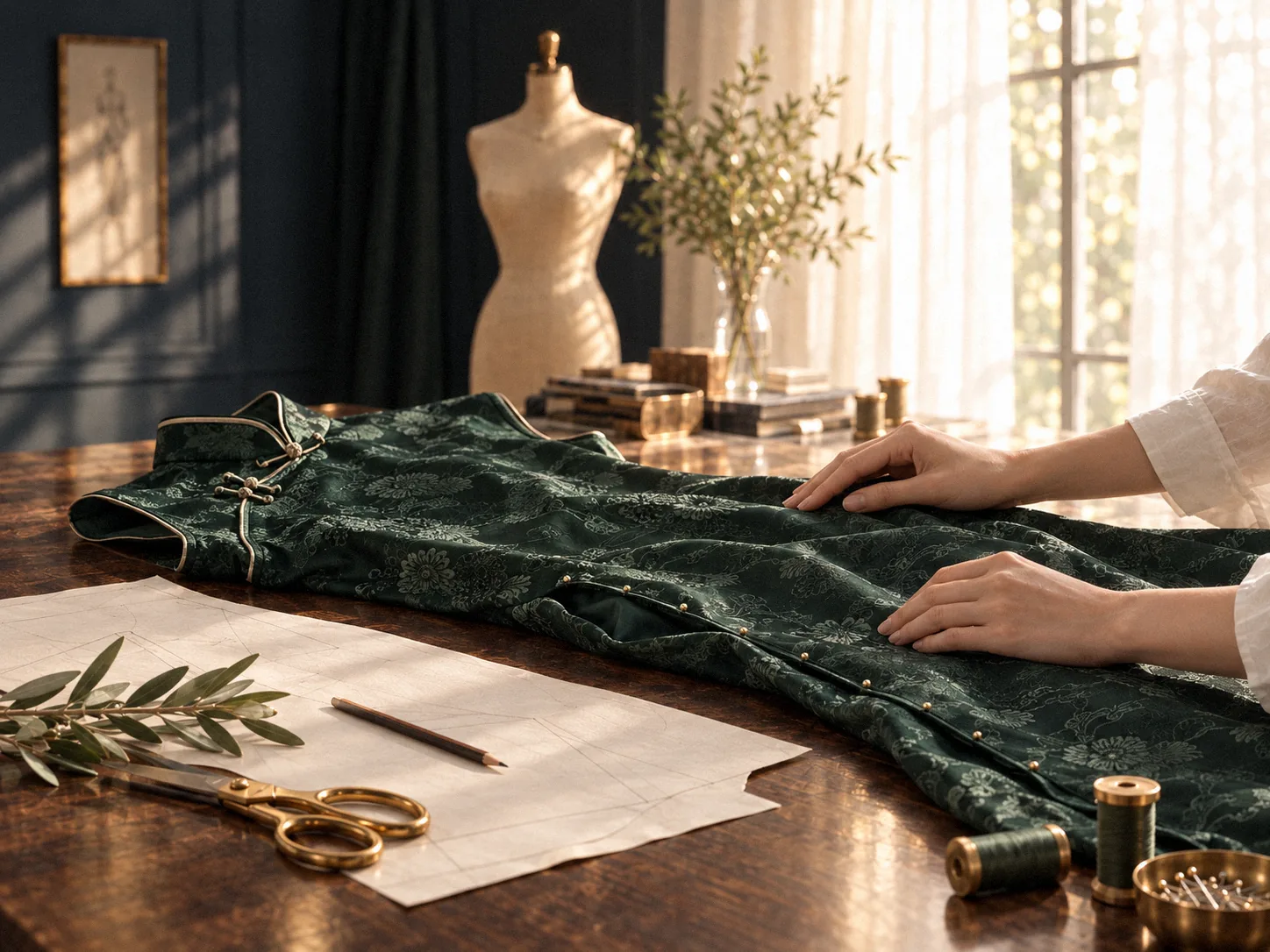
Some garments are not garments first
Some qipao arrive at the studio without the client saying, at first, what she wants changed.
She may begin by telling me that her mother wore it when she was young; that a family photograph from that year shows her in it. Or that it has been kept for many years, no longer fits, no longer suits the present, and yet every time the wardrobe opens, she cannot bring herself to set it aside.
I understand this feeling very well.
The value of an heirloom garment was never only in the cloth, the cut or the label. It is in the knotted buttons touched by fingers, in the time left on the edge of the collar, in a memory you may not be able to tell in full but know you cannot lose.
So when a mother's qipao is in front of me, I do not begin with “What would you like it to become?”
I begin with: what do you most want to keep?
First: write down what cannot be lost
The qipao is easily misread. Its line looks simple, as though taking it in, shortening it and replacing the zip would be enough to wear it again.
But the details of a qipao are exactly the parts that must not be moved carelessly. The placement of the knotted buttons, the curve of the piping, the direction of the embroidery, the symmetry of the pattern across front and back, the height of the slits, the proportion of the collar against the neck: all of it describes the garment's original character.
At the first assessment I ask the client to list with me the “elements that must be kept”. It may be a pair of buttons, a passage of hand embroidery, the cuff her mother loved most, or simply the colour of the cloth in the light. We write it down not for sentiment, but because once we begin to open the garment, some choices cannot be undone.
What an heirloom needs most is not courage, but clarity.
Second: how much new strain can the old cloth bear
Time stays in cloth.
Some old qipao have been kept beautifully; the fabric is still resilient and the lining stable. Others, through humidity, light, cleaning or years of folding, have weak points in the silk, cotton-linen or blend. The surface looks whole, but at the underarm, side seam, collar or slit edge the cloth may no longer take repeated pull.
This is why I will not promise from a photograph that “your mother's qipao can become your evening dress”. The difference in figure, the amount of cloth, the seam allowance, the lining and the position of the pattern can all change the answer.
Sometimes the best course is to keep it whole and repair it finely. Sometimes it can be worn again, but differently. Sometimes what deserves to survive is a passage of embroidery, a row of buttons or one special piece of cloth, rather than the whole silhouette kept by force.
This is not giving up. It is choosing the most honest next life for the garment.
Third: preserve, repair to wear, or transform?
Every heirloom qipao has to choose between three paths.
Preserve as it is
If the workmanship is intact, the emotional value very high, or the fabric unsuited to being opened, preservation may be right. The studio's work then leans toward stabilising, reinforcing, tidying and advising on storage, rather than forcing the garment back into daily wear.
Repair to wear again
If structure, fabric and seam allowance permit, a qipao can be refitted while keeping its main silhouette: correcting the lining, working local seams, adjusting length slightly, improving comfort. This calls for restraint. The aim is not to make an old qipao look new, but to let it be worn well today.
Transform
When the original silhouette no longer suits, or only part of the cloth is worth saving, transformation may be the more living path: a new top, a skirt, a detail on a shawl, or the single most important passage of memory inside another garment.
Transformation is not cutting the old garment to pieces. A good transformation keeps what most deserves to be remembered, then tells the story again in today's proportions, purpose and body.
A qipao's proportion is never just a size
The qipao is honest about the body.
Collar, shoulder, bust and waist, hip, slit and length are tightly bound to one another. Change one and the feeling of another shifts. In older qipao especially, the original cut and the way we hold our bodies today may not agree; take it in or let it out by numbers alone and the balance is easily lost.
So at a fitting I do not only look at the client standing. I watch her walk, sit, raise her arms, turn. Where does she want to wear it? Does she want to feel elegant in it, or to feel like herself? The answer changes our direction.
Fine alteration does not make the body yield to the dress. It teaches the dress to understand who you are today.
A memory need not be whole to be kept
Many people feel that unless the whole qipao is kept untouched, they have failed it.
I do not see it that way.
Memory never lived only in a complete silhouette. Sometimes a pair of buttons is enough. The piping of a collar, a piece of embroidery, the familiar touch of a cloth can carry a person's presence into the next garment.
What matters is whether you have chosen, seriously, what to keep. Not to follow fashion, not to leave everything untouched out of reluctance, but, having understood the garment, to let the relationship continue.
We go slowly, because some decisions should not be rushed
Once an heirloom is opened, some changes cannot be fully reversed. This kind of assessment takes time, and enough trust between the client and the studio.
We look at the garment first, record the elements to be kept, talk through the risk of each possible path, and only then decide whether to go further. If a piece is not suited to transformation, we say so. Sometimes preservation is itself the best choice.