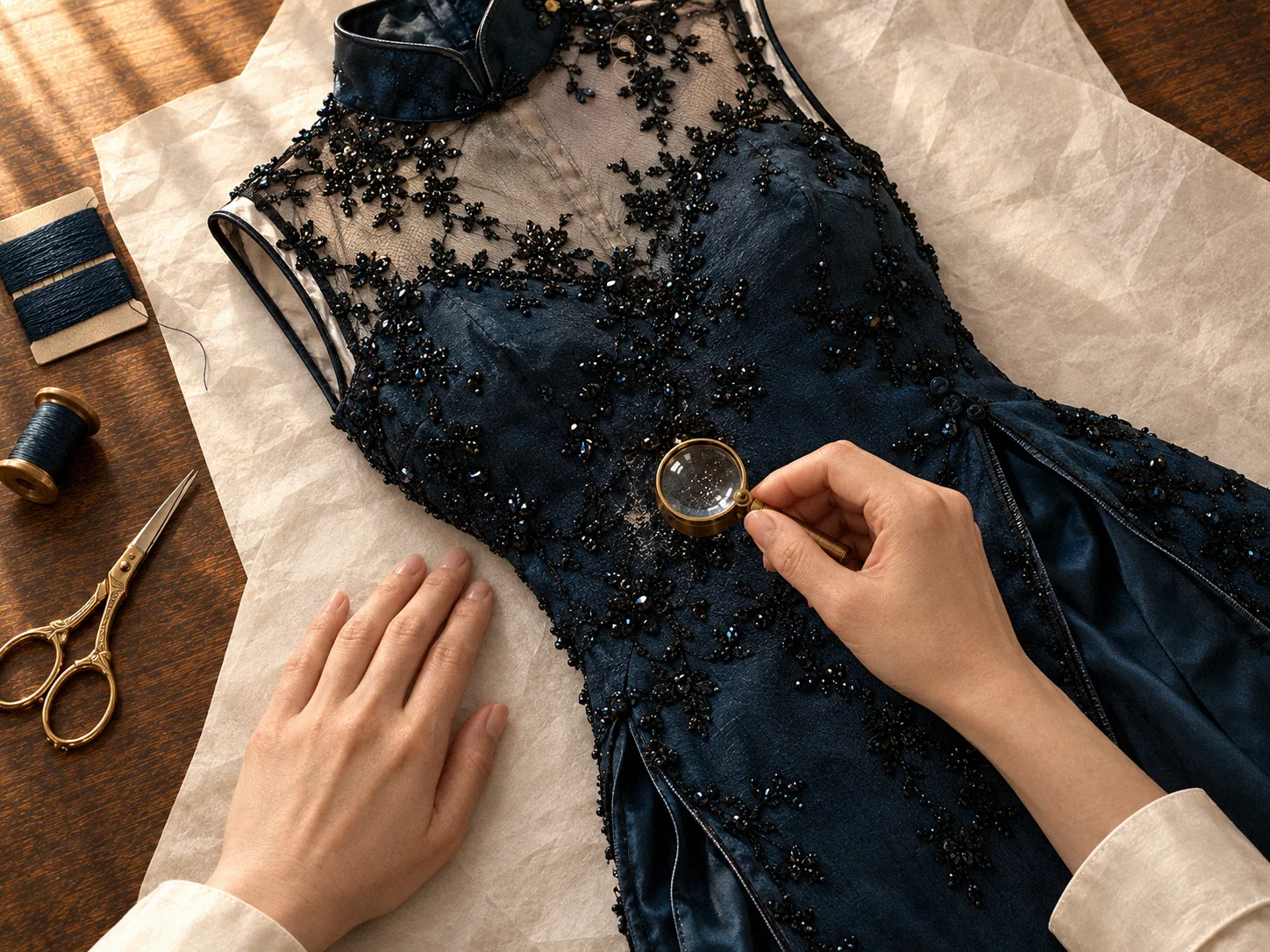
Slowing down is the first procedure
A client lifts her grandmother's qipao from its box and usually hurries to show me: this has split, there is a hole here, can it be mended? I ask her to let me lay it flat on acid-free tissue first and do nothing but look for ten minutes.
The state of an old qipao is not known from the hole. Over decades silk loses its spring; the surface looks whole while the fibre has turned to powder and snaps at a pull. The dye may no longer be fast and will run at the first solvent. The thread may have aged faster than the cloth. None of this shows except with no strain on the cloth at all, examined slowly by eye and loupe.
Hurrying to repair a fragile qipao is often the greatest harm one can do it.
The static check: light, thinning, cracks
I hold the qipao to the daylight first. Aged silk thins unevenly, and the thin places glow brighter than their surroundings. Then the surface: fine cracks, especially along folds and seams; crushed or bald pile on velvet; metallic threads in brocade that have oxidised dark. Then the fibre under the loupe: healthy silk has lustre and spring; powdered silk looks dull and granular and sheds at a touch.
This step decides whether the garment can be touched at all. If the static check already shows widespread powdering, the movement test is unnecessary; the answer is plain.
The gentle movement test: one simulated sitting
If the static check passes, I apply a very light movement test: a gentle pull with the fingertip near a seam, watching whether the cloth splits or lifts at once. Then the qipao goes on the form and I simulate the strain of sitting at the waist, hip and slits, looking for any new opening. The force is far below normal wear. The aim is not to find the limit but to confirm that the garment can bear even the most basic movement.
Protective reinforcement before unpicking
When stitching has loosened or small cracks appear around embroidery, the instinct is to unpick the seam and re-sew it. On a fragile qipao this is usually wrong. Unpicking adds one more pull to an allowance that is already tired, and the new needle holes fall beside the old ones, turning that line into a row of perforations.
My approach is to back first: a sheer net or silk backing inside, with fine distributed stitches stabilising the area around the split, so that the backing takes the strain rather than the old silk. High-risk areas such as the underarm and slits are given temporary reinforcement and watched for a while; only once they are stable do we consider whether a formal repair is needed at all.
When the answer is “do not open it”
Some qipao split during the static check or the gentle pull. Then any opening or major change risks irreversible damage, and I tell the client plainly: this qipao should not be repaired to a wearable state. That does not mean there is nothing to be done. It can be protectively reinforced and stored flat, kept as it is; its pattern, measurements and details can be fully recorded and a new one made to match; or its sound knotted buttons, piping or embroidery can be lifted and worn on another garment.
Where the studio draws the line
If the fabric splits under the static or gentle-pull test, any opening or major change may cause irreversible damage, and we replace unpicking with protective reinforcement. The final approach is confirmed by a sample on the garment before it is carried out. We would rather say “not advisable” than take that risk to complete a job.