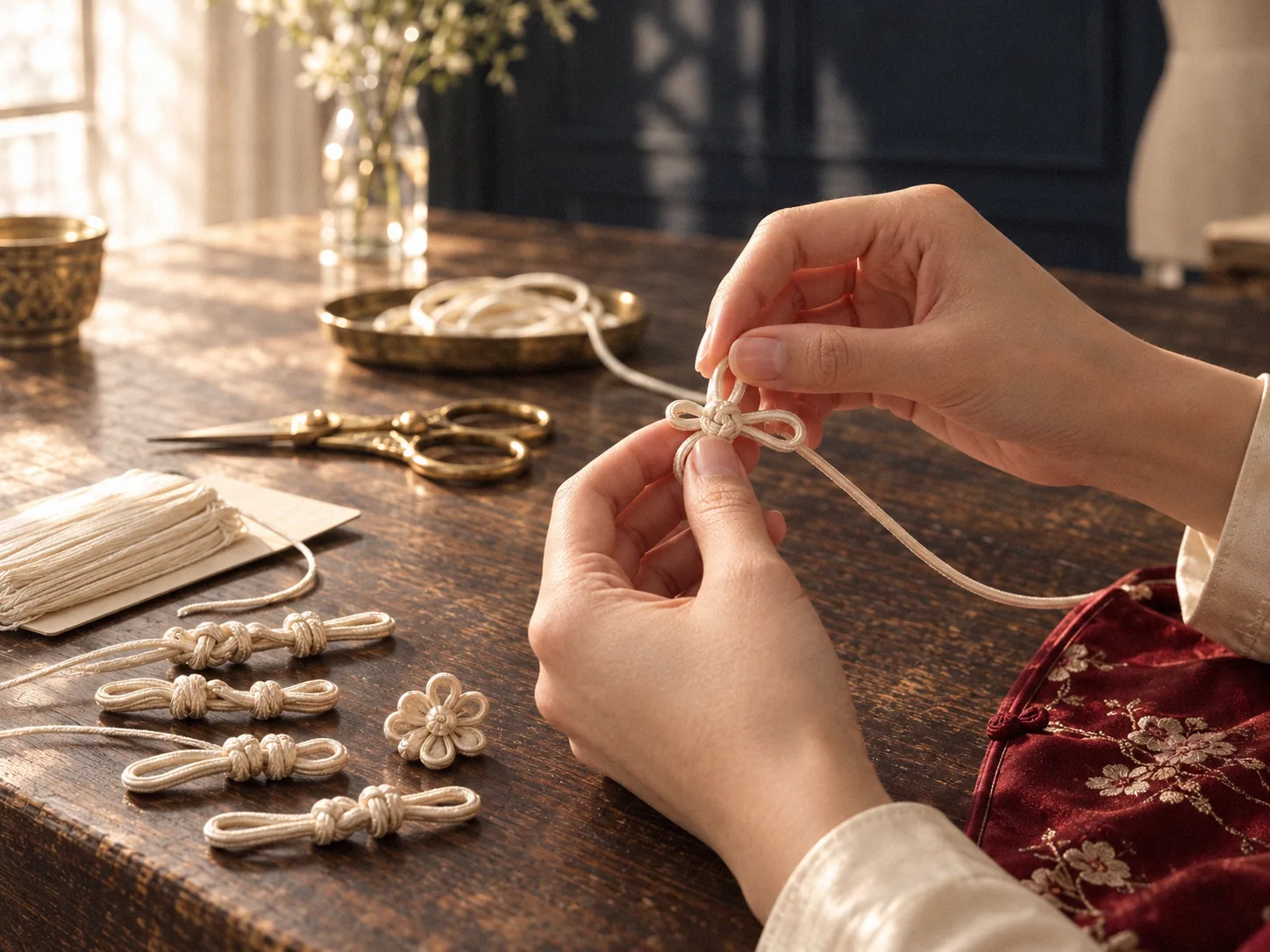
First see how the button is made
A knotted button looks like a knot, but it is three layers. Outermost is the rouleau: a bias strip of silk, satin or velvet sewn into a fine tube. Inside is the core: cotton cord, copper or iron wire, and on some old qipao, twisted paper. Then the hand: straight knot, pipa knot, flower knot, butterfly knot, each with its own method and tightness.
When a button fails, we first find which layer has failed. A worn rouleau may hide a sound core; a rusted core stains and splits the wrapping from within; a loosened knot deforms the whole button. Three problems, three treatments.
Do not say “replace the set” the moment a button fails. Often only one layer has gone.
The button is intact, only loose: re-sew, and reinforce the base
The most common case: the button itself is sound, but the thread holding it has loosened or broken. Re-sewing the original is the best choice. But first I look at the base: has the small area of cloth beneath the button been thinned, pulled or perforated by years of strain? If so, simply sewing it back will loosen again soon.
So when re-sewing I add a small compatible backing inside, spreading the button's pull over a wider area, then sew it back along the original stitch marks with silk thread close to the original. From outside, position and stitching look exactly as before.
Brittle wrapping or corroded core: remake
If the wrapping has grown brittle and cracks at a touch, or the core has rusted and split the button from within, that button can no longer take daily fastening. Remaking is the stabler choice. I find the closest fabric for the rouleau, ideally spare cloth from inside the qipao itself so colour and sheen agree; use a core that will not corrode; and tie a new button in the original method and tightness.
I say plainly: a remade button feels slightly different. New rouleau is a touch firmer than old, and the knot a touch tighter. In wear it is not noticed, but set a new and an old button side by side and you will see it.
One sample button first
Precisely because there will be a difference, for a client who values the original look I always make one sample first. I set it on the qipao beside the originals and we look once in daylight and once under lamplight. Then we decide together: replace only the failed buttons and accept the subtle difference, or replace the whole set for consistency and return the originals safely kept. Both are reasonable; the choice should be yours, made in front of the garment.
How it is fixed decides whether it fails again
Half a button's life is the button; the other half is how it is fixed. Following the original stitching respects an old garment; but if the original method was itself the cause, say the button was sewn to a single layer of face fabric, I suggest a backing or a small mounted base inside so the pull no longer lands directly on the cloth. All of this sits inside, unseen.
Where the studio draws the line
We cannot guarantee a perfectly traceless restoration. Where button material is missing or the base cloth is damaged, remaking or backing is the way, and what is feasible, and how visible the difference will be, can only be judged on the garment, from the cloth's thickness, the seam layers and the original stitching. On antique pieces we keep the original position and stitch marks and intervene as little as possible.