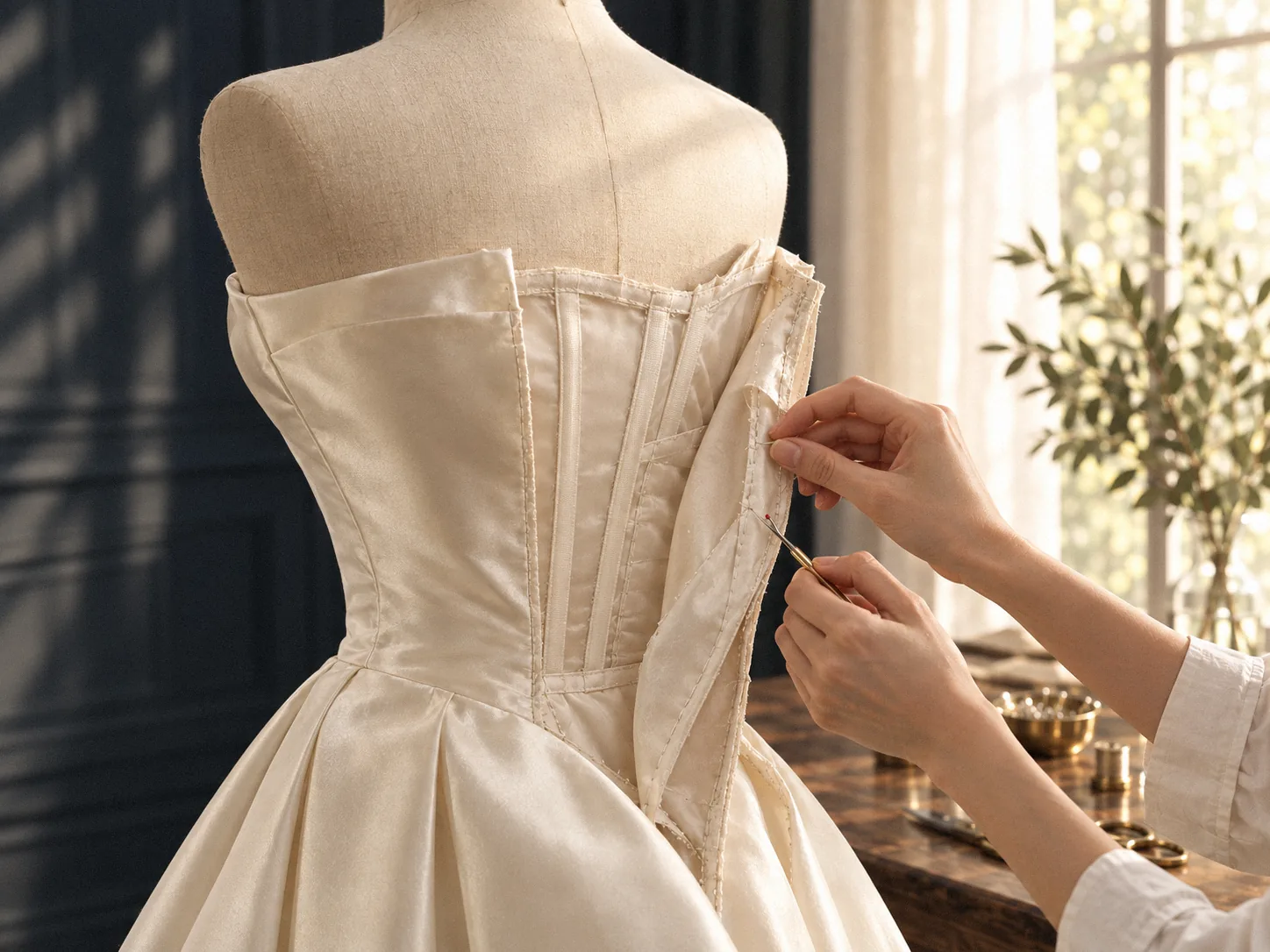
Evening Gowns, Bridal & Formalwear
What makes a gown compelling is how effortless it looks under the lights. This branch is about the structure no one sees but everything depends on: shoulder line, bodice, lining, boning, beadwork and hem.
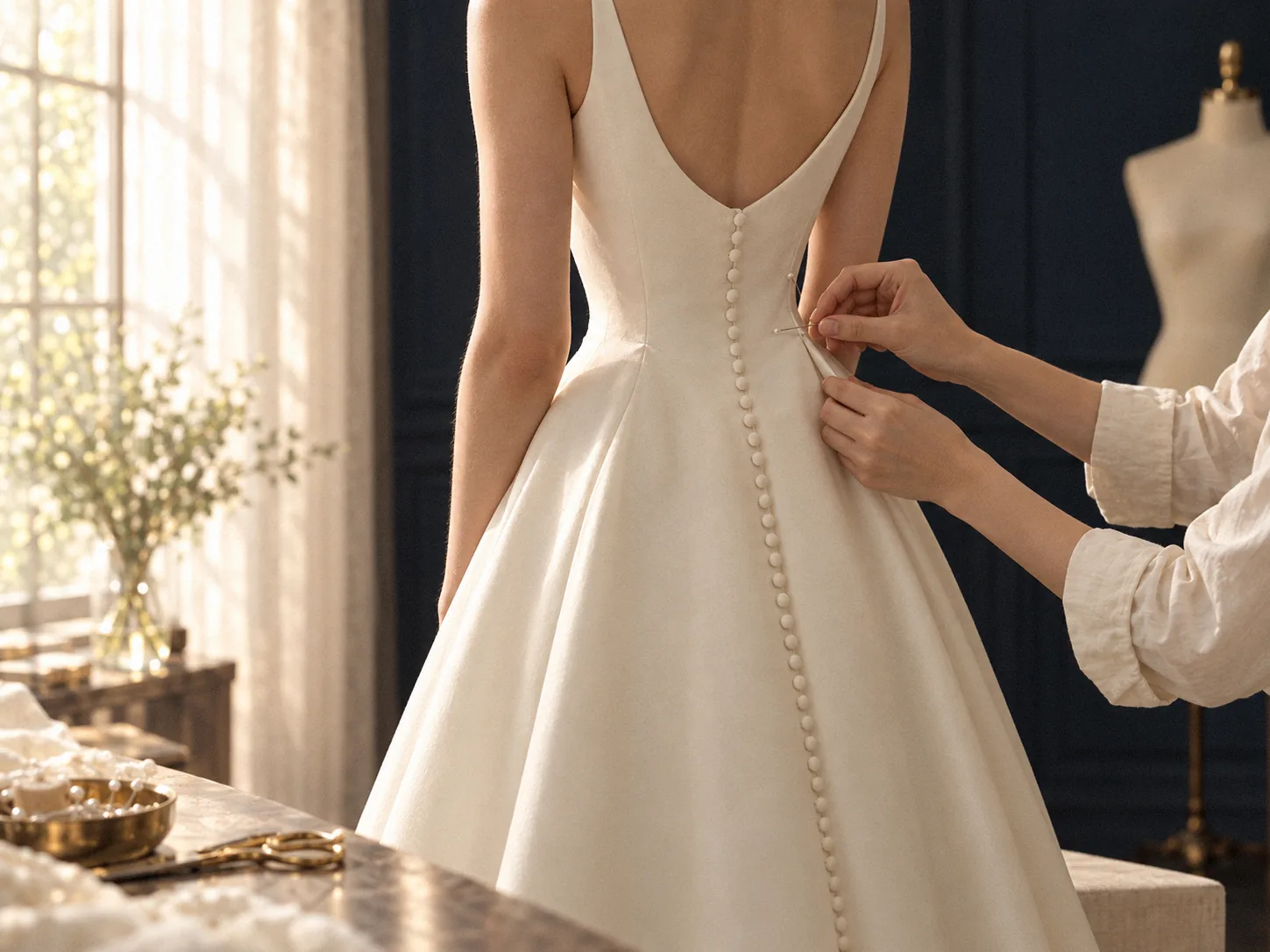
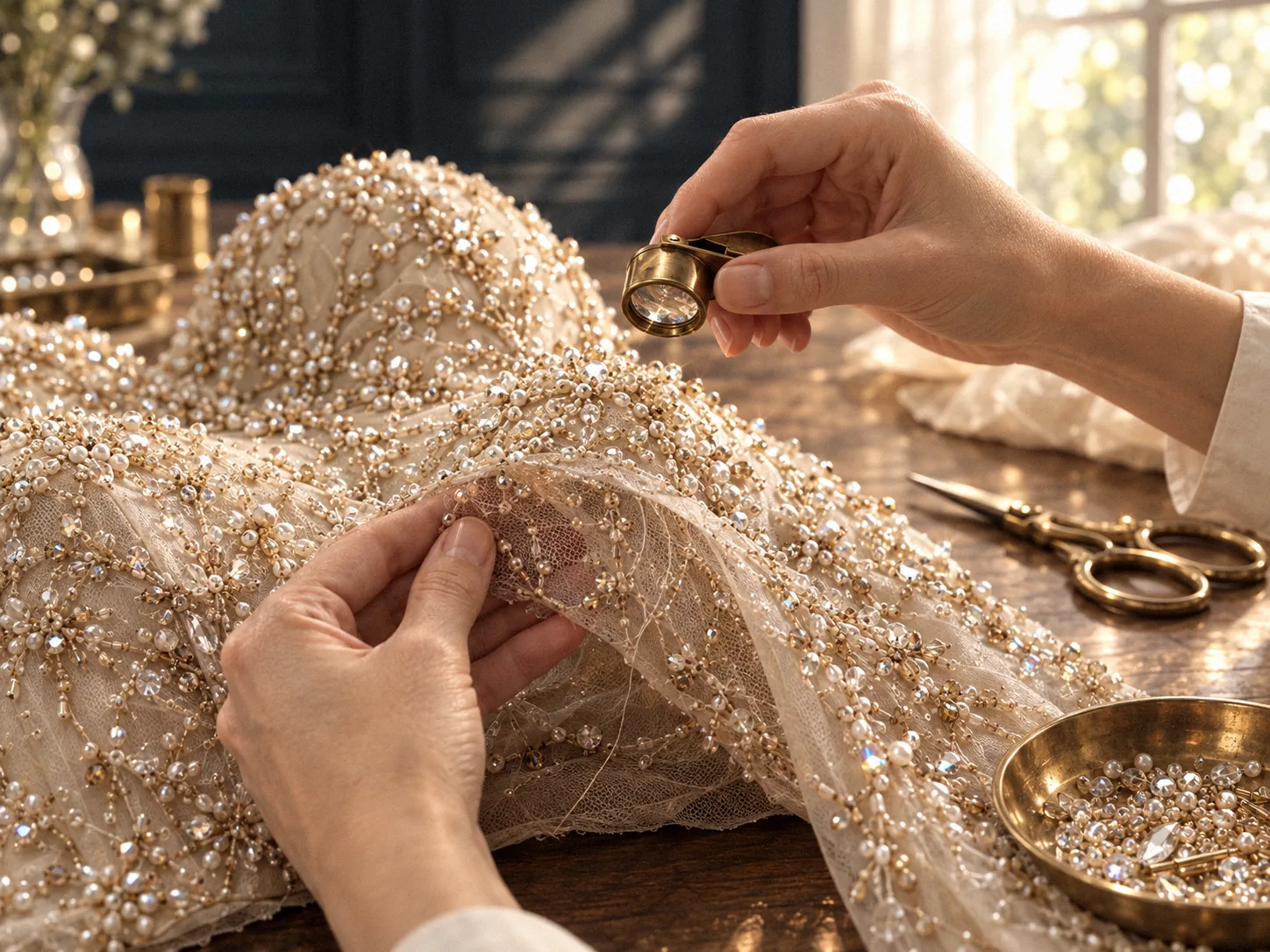
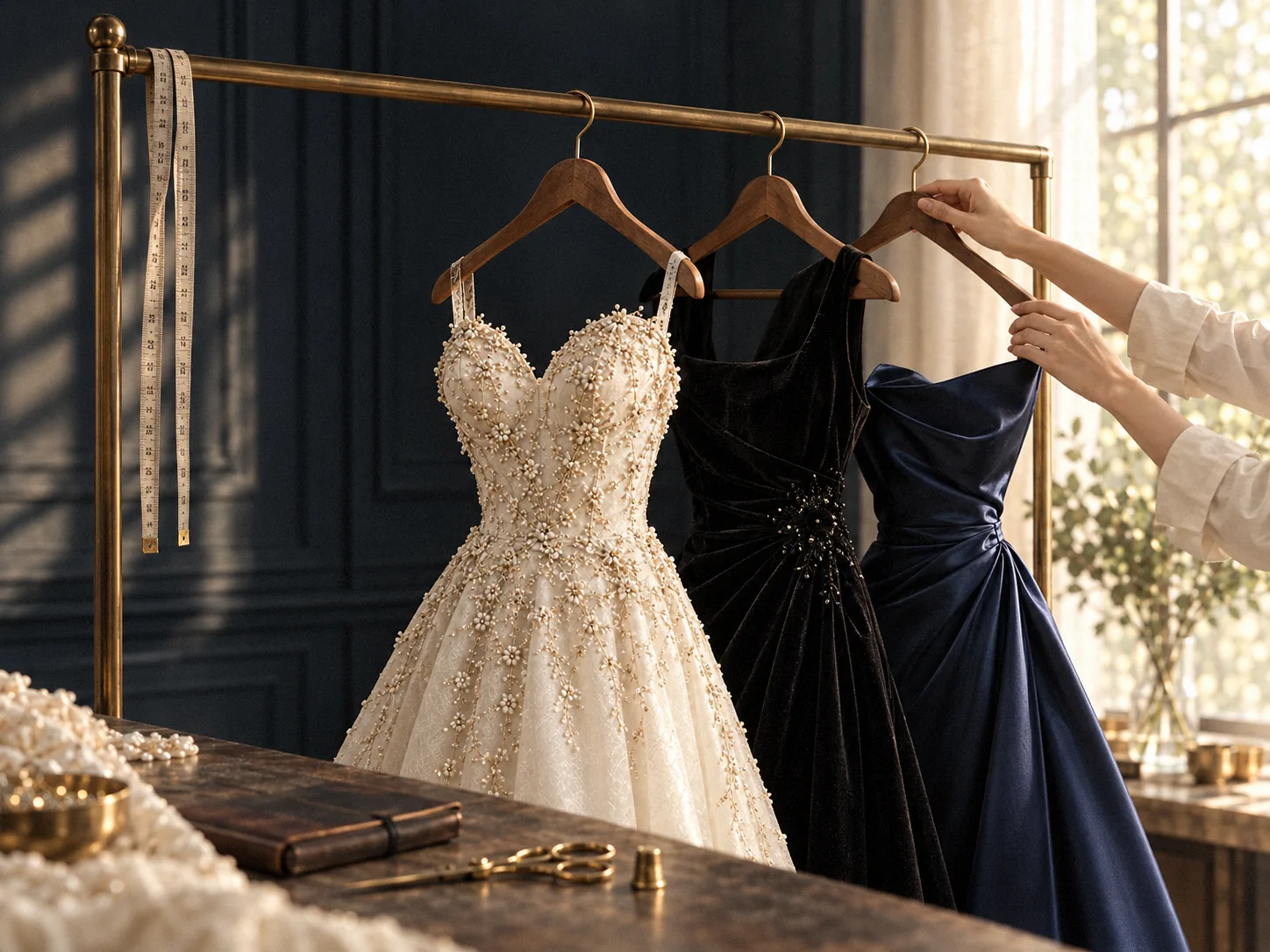
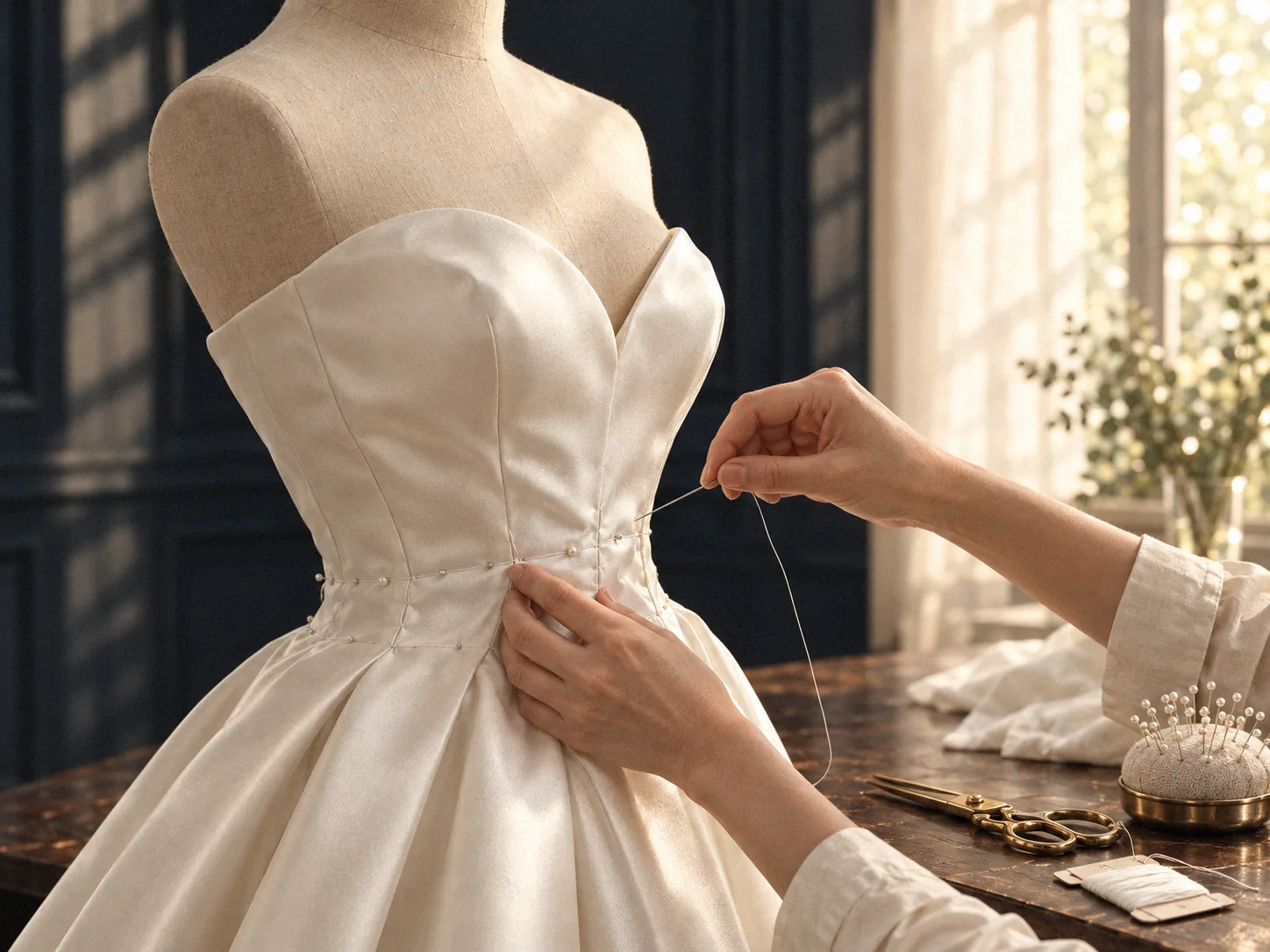
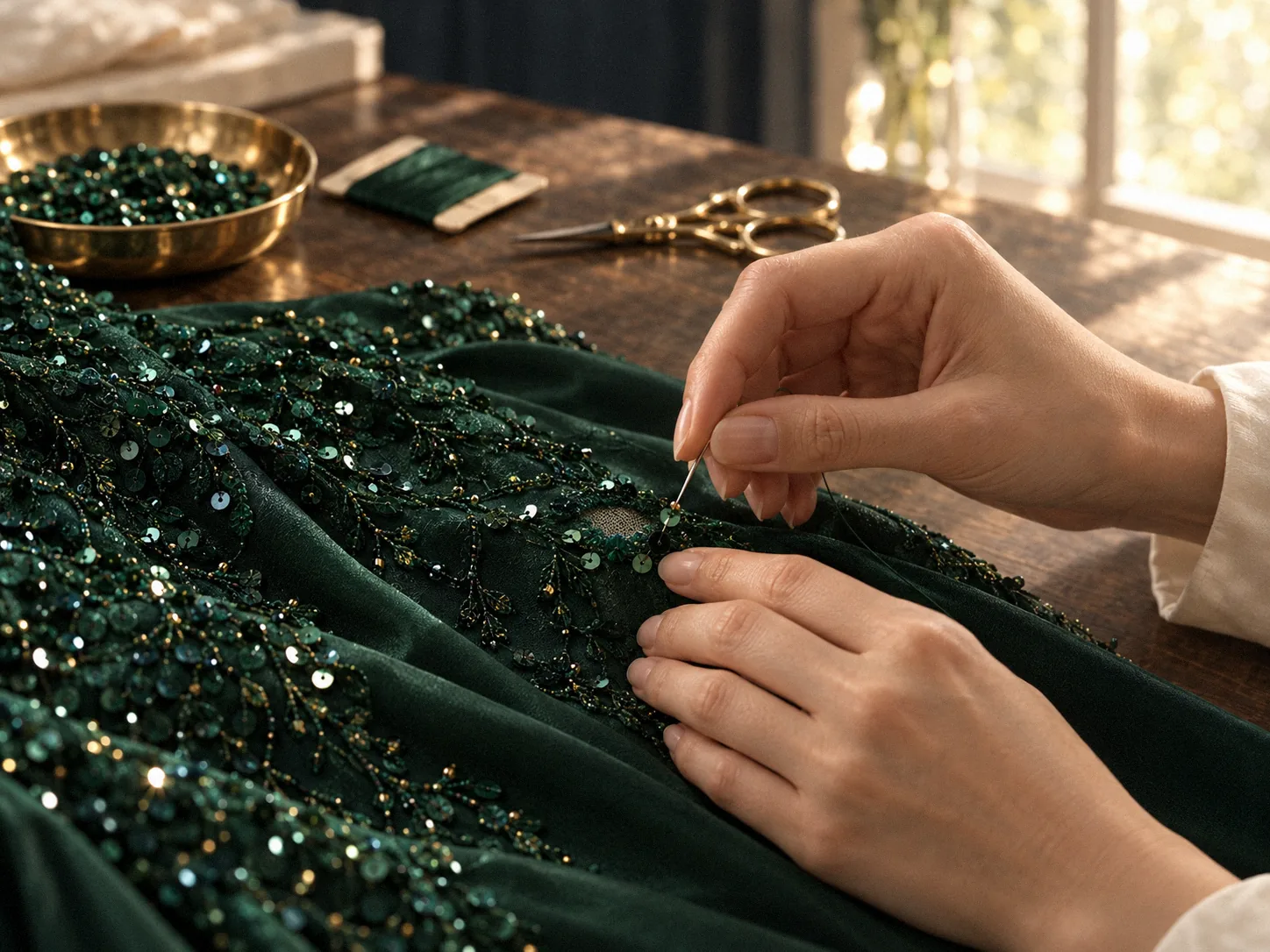
24 knowledge cards in this branch
Each card answers one question clients often ask: a direct answer first, then the judgement behind it. Open a card by its title; every card has its own link, so you can share it with a friend or family member.
Cards are the short form of the guides. If your garment is in a more complex state, read the related guide first, then book an assessment.
E062What must be checked before shortening a gown?
First separate the layers of the hem: face fabric, lining, petticoat or hoop; then see where beads, embroidery or lace edging sit. Hoops and beading limit how much can come off and how the edge is finished.
If the face and lining differ in length they must be shortened together or the inner layer shows. Decoration at the hem edge means removal or relocation, and the re-laying must be weighed. Light bias-cut cloth changes its fall when shortened, so it is adjusted at a fitting rather than cut in one go.
Link to this card · E062E064How are trains and hems handled?
Train length, hoop stiffness and hem width together decide comfort in walking and sitting. A long or stiff train needs a dependable bustle, or a detachable design.
Too stiff a hoop pushes the balance forward and shortens the stride; too soft loses the shape. Hem proportion follows height and heel. Decisions are made from the floor line and movement in the real shoes. Hoops with several stiff layers, or trains with metal fittings, must be examined before any change.
Link to this card · E064E066What matters with sequinned and beaded garments?
The pattern direction and the way sequins are stitched decide whether they can be moved. Machine-sewn lines leave visible holes when removed; hand-scattered work takes far longer to re-lay.
Removing sequins from stretch net enlarges the holes. Small areas are patched with matching sequins; where a seam must move, sequins over the affected area come off, go back in the original direction and density, and the lining is reinforced against future loss. A trial in an unseen spot comes first.
Link to this card · E066E067How is a lace gown assessed?
By the continuity of the pattern, the firmness of the net and the edge finish. A join hides more easily where the motif has a symmetrical node; a random pattern is hard to join invisibly.
A loose net runs when cut and needs reinforcing first. Rolled edges and embroidered overlaps each need a compatible finish. We piece or re-embroider to keep the pattern before considering backing or a new edge. Lace with metallic thread or special dye is matched for colour and fixing together, and every cut is tested on the gown first.
Link to this card · E067E068What about altering silk and satin gowns?
Silk and satin slip, hold needle marks and take pressing shine. Work relies on invisible seams, fine needles and short stitches, low-temperature pressing through a cloth, and a stable lining.
Layers are fixed with fine pins or soluble thread before sewing to keep the line true. Reshaping thin silk often means remaking the lining or adding a light interlining to keep the drape. Where the surface already shows cracking, wear or colour change, work is conservative and a patch plan is kept ready.
Link to this card · E068E069Can a boned bodice be altered?
Yes, but the boning, cups and lining form one structure. Sewn-in bones take many steps to release; channelled bones adjust more easily. Moving a bone changes the load on the straps, side seams and waist, which must be assessed together.
Removable cups can be adjusted or replaced; bonded cups affect the bust shape when changed. The principle is minimal intervention: whatever achieves size and comfort without opening the main structure comes first. Bones sewn through several layers, or aged metal bones, must be examined in person.
Link to this card · E069E070How are straps and necklines adjusted?
Straps, neckline and bust affect one another. Changing the straps alone shifts where the bust sits; changing the neckline may involve the cups and lining. They are adjusted together at a fitting.
At the fitting we try different strap lengths and anchor points, watching whether the bust lifts or drops and whether the neckline gapes. Strapless and off-shoulder designs need the side seam and inner anchors reassessed, sometimes with a hidden silicone strip. Every change is checked standing, sitting and with arms raised.
Link to this card · E070E071How are evening gown sleeves altered?
First the fabric weight, seam allowance and how beads are fixed. Single-layer tulle without allowance puckers if the cuff is simply narrowed; with a lining or cuff band, the seam can move while the outer texture stays.
Beads on a fine base are removed locally, the area reinforced, then re-sewn. Shaped sleeves such as bishop or lantern sleeves may need the sleeve head adjusted when shortened or narrowed. Visual detail is protected first; structural change, where unavoidable, is made with reversible stitching.
Link to this card · E071E072How are horsehair hems and edges handled?
Horsehair, layered net and lining decide the skirt's shape and how it meets the floor. Shortening is never only the outer layer: the horsehair and lining must be adjusted with it, or the hem misaligns and the support fails.
Usually the horsehair width is adjusted or new braid set in, to keep the spring and curve of the edge. Hand-rolled or beaded edges are removed and restored in the same technique. Where horsehair is sewn into the face fabric with no allowance, the support layer is usually remade after shortening.
Link to this card · E072E073How is comfort for dancing and sitting checked?
The fitting simulates lifting, raising the arms, striding and sitting for a while. Cloth that pulls when the arms lift or the legs stride means the side seams need easing or the cut needs more curve; sitting reveals pressure at the bust and waist.
For long seated occasions an elastic band inside the waist spreads the pressure; for dancing, a hidden movement pleat or side slit helps. We simulate the most frequent movements first, then achieve comfort with the least intervention. A very tight cut or no allowance limits what can be done.
Link to this card · E073E075How should a gown be transported and stored?
Hang flat in a breathable bag and avoid folding; support the shoulders with pads or tissue; turn beadwork inward with a fine cloth between. For long journeys, support the gown flat and never set weight on it.
If folding is unavoidable, place tissue at the folds and keep them off the decoration. Light creases lift with steam or low heat; very fine or beaded cloth is steamed from a professional distance. A gown with loose beads or a fragile lining needs professional handling and flat storage rather than ordinary hanging.
Link to this card · E075E076What matters in fitting a mother-of-the-bride gown?
A stable shoulder line, ease under the arm, and well-judged support at the waist. Small changes keep the gown's proportion and dignity, balancing composure with all-day comfort.
Where the bust needs shaping, removable pads go into the lining; the underarm and cuff gain ease through the side seam or a hidden elastic. The waist is smoothed by reworking the lining and local shaping bands, not by pulling it tight. A fragile lining or straps limit what can be changed.
Link to this card · E076E077Should an antique wedding gown be kept or altered?
First assess the fragility of the fabric, the seam construction and the family value. Where cloth is cracking or heavily bonded, we usually suggest documenting, local repair or transformation rather than full re-sewing.
Century-old silk, cotton or linen is often yellowed and brittle. Structural failures such as a torn lining or broken straps come first, with the original decoration and stitching kept. Where repair is too risky, transformation is the alternative, such as turning a lace collar into a stole, with samples and records retained.
Link to this card · E077E078How can a gown live on after the ceremony?
Shorten the skirt, remove the grander trims or rework the bodice into a dress, top or stole. A train can become a detachable cape; heavy embroidery can move to a cuff or a small panel at the chest.
The bodice can become a separate jacket, with shoulders and closures reinforced. A skirt cut to the knee may need its hem support remade to keep the line. We keep as much character as possible with as little damage as possible. Decoration sewn tight to the main cloth, or fabric already repaired in places, raises the risk.
Link to this card · E078E079When should a gown not be altered?
When the fibre is fragile, seams are heavily bonded, or decoration is sewn tight to the main cloth with no allowance, major alteration is unwise. Opening it loosens detail or cracks the surface.
The other case is a structural change too large for the available cloth, such as resetting the shoulders or remaking the whole hem support. Here we stop first and suggest local reinforcement, transformation or documentation, explaining the risk and reversibility of each path.
Link to this card · E079E082Will adding interlining to the hem affect how it moves?
Yes. Interlining adds fullness and shape, but also weight and swing. Horsehair braid gives a lively spring that carries more momentum in a fast turn; a light net interlining improves the shape without adding weight.
For a ball with much turning, light and supple support comes first; for ceremony and photography, a firmer interlining holds the line. For natural flow, thin interlining with horsehair only at points controls the weight. Where the original allowance or backing is weak, a fitting decides whether reinforcement is needed.
Link to this card · E082E083What should I know about changing strap material?
Going from a thin strap to a wide one changes how the load travels. We check whether the shoulder seam and bust panel have the cloth and lining to carry the wider pull, reinforcing the seam or using detachable straps where needed.
A soft silk strap can be sewn invisibly with a backing inside; a firmer woven strap needs a reinforcing tape or pad inside the shoulder seam. Wide straps change how the bust reads and the panel may need repositioning. On fine or densely embroidered gowns a stitched sample is tested first.
Link to this card · E083E084Can a gown have built-in cups or bust support added?
Yes. Built-in cups give a smooth outline and suit silk or close-fitting styles; removable pads are more flexible. Any added support slightly changes the bust outline and the pattern, so thickness and position are set at a fitting.
Boning or soft steels suit styles that need firm shaping, at the cost of stiffness when seated. Fine fabric may show pull lines once supported, and the outer layer or a soft interlining is adjusted to balance it. Where the existing lining is very thin or aged, it is reinforced first or a removable option used.
Link to this card · E084E085How is colour difference in a lace join handled?
With lace, the difference lies in transparency and sheen rather than shade. We choose lace of the same base fibre and openness, set the join where the pattern hides it best, such as a flower centre or leaf edge, and grade with local dyeing or layering where needed.
Original and new lace take dye differently, so a slight difference may remain. A sheer backing or fine net inside the join softens the light. The order is match first, then hide by placement, and only then dye or layer. Lace is fragile, so a sample is made before touching the gown.
Link to this card · E085E086How is decoration kept when a zip is replaced?
Re-usable trims are removed carefully and their positions marked, then returned; where decoration cannot be fully re-sewn, an invisible zip is fitted and a fine trim kept on the outside as a cover.
On a close-fitting gown the zip takes real strain, so a reinforcing tape or double allowance goes behind it. Metal trims are kept clear of the zip or separated by a soft pad. Where zip and trim have been sewn together for years and the thread has weakened, removal may harm the cloth and the risk is assessed first.
Link to this card · E086E087How is a long train bustled and released?
Buttons, hooks or small magnets are fixed to the lining or underlayer, never through the face fabric, with a small reinforcing patch at each load point. After the event the fixings are removed and the cloth checked for holes or pulls.
Anchor points avoid heavy embroidery and fine cloth. Bustled, the train lifts when standing and does not pull when seated. Fixings are tested with removable materials and a walk-through before being finalised. On finely embroidered or fragile lace trains, non-piercing clips or professional buttons are used instead.
Link to this card · E087E088Can a gown's contrasting lining be turned outward and re-used?
Yes, but not by simply turning it out. Linings are usually thin and plain, and exposed they show raw edges and stitching; the material must be checked for strength, edges bound or layered, and the contrast with the outer cloth balanced.
We first place a section of lining in the outer position to judge colour and fall, then decide on reinforcement or recutting. Where the lining is too fragile or too stretchy, we suggest re-using panels or an exposed insert rather than a full reversal.
Link to this card · E088E089Which fabrics behave under stage lighting?
Under strong light, matt or softly lustrous satin stays calm; sequins and mirror finishes throw hard reflections and glare, and detail is lost in photographs. Sheer tulle can turn translucent when backlit and may need a backing.
Keeping sequins out of direct light, or using them sparingly, avoids flicker. Distance from the stage, the angle of the lights, camera flash and the movements involved all shape the choice. The surest test is to try the gown under simulated lighting.
Link to this card · E089E090How is a hem lengthened without a visible join?
The join is placed on the line of an existing seam or inside the hem, the panels aligned to the grain, and the hem weight adjusted to keep the line. Striped, napped or lustrous cloth must be matched exactly.
The added cloth must match in weight, drape and dye; where a full match is impossible, the join sits in a natural fold or decorated area, or is softened with a band or lace edge. Added length changes the swing, so a little weight or horsehair may go into the new hem. If the original has faded, the join may still show, and this is judged in person.
Link to this card · E090Thinking of a particular piece? Bring it, and we will read it together.
Back to the encyclopaedia