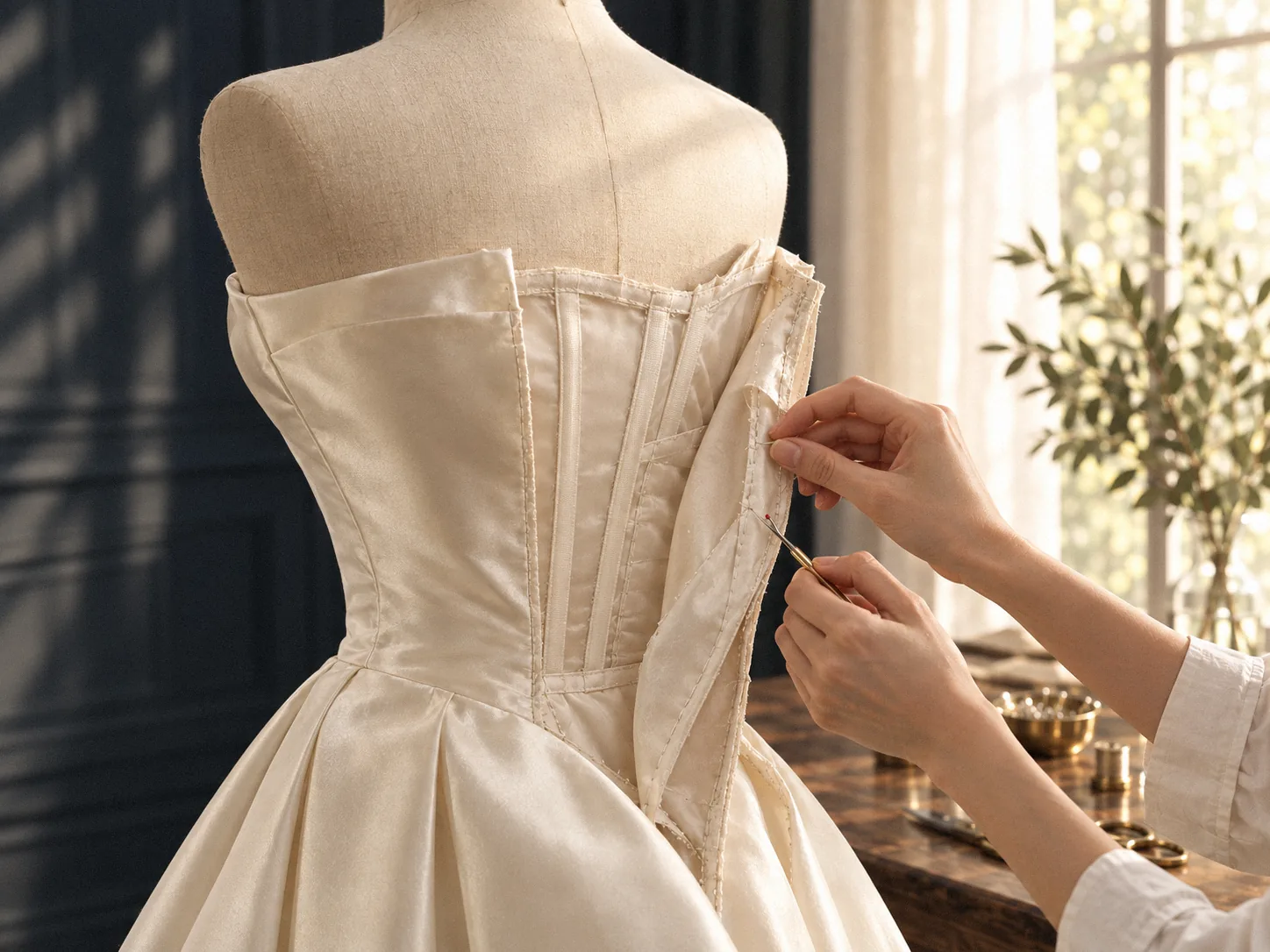
The beauty of a gown usually begins on the inside
What makes an evening gown so compelling is how effortless it looks under the lights.
The curve of a shoulder, the placement of a waistline, the speed at which a hem falls — all of it seems simply to happen. It does not. In a gown with a bodice, boning, beadwork, tulle or several layers of lining, every light effect is held up quietly by structure.
In more than twenty years of making couture and formal gowns, the sentence I say most often to clients is this: do not ask first whether it can be made smaller; let me see first how this dress stands up.
Some gowns look as though they need two inches off the waist and nothing more. Open them and you find that the bust is actually held by the inner boning; that the waist is crisp because the pull of the outer satin and the lining happens to balance; that the hem has weight not because the fabric is thick, but because several layers of interfacing, cut on different grains, are holding it.
Alteration is never one cut. Read first; then decide how to begin.
One: the shoulder and bust decide whether a gown has life
Most clients look at the waist first. I usually look at the shoulder line, the neckline and the bust.
A gown can be taken in perfectly at the waist and still look tired if the straps sit too far out, the neckline gapes or the bust is not properly supported. In off-shoulder, one-shoulder, deep-V and fitted-bodice designs especially, shoulder, bust and waist are never three separate problems.
Shortening a strap is not simply sewing it shorter. It means reading the slope of the shoulder, the pull when the arm lifts, whether the edge of the bodice will ride up, and where the gown's visual weight was designed to sit. Too much and the bust is lifted unnaturally; too little and the stability is lost.
A good gown alteration should never read as “this was altered here”. It should read only as: this dress finally belongs to you.
Two: the real support is in the lining, the boning and the seam allowance
What you see outside is satin, lace, tulle and beads. Inside is the skeleton.
Many formal gowns are far more complex inside than out: boning that holds the curve of the waist, layers of net that lift the skirt, a bust built from structural canvas, pads and anchoring tapes. Once these are opened, the job is no longer “alteration”; it is rebuilding a small piece of architecture.
I do not say yes simply because a client says “just a little”. I need to see whether there is enough seam allowance; whether the boning has aged; whether the lining has gone brittle from perspiration, time or dry-cleaning; whether the beadwork sits exactly over the seam that would have to be opened.
Sometimes the right answer is not a major alteration but a fine adjustment inside, so the body is supported more precisely. From the outside the gown looks almost untouched. The moment the client stands up straight, she knows the difference.
Three: a hem is never just long or short
The hem is the most underestimated part of a gown.
Clients often say, “I'll wear higher heels, so the length should be fine to change.” I understand. But length is never only a measurement. There may be crinoline, horsehair braid, a lace border or a beaded motif at the hem, and there is the drape of the fabric itself. Will satin lose its flow once shortened? Will layers of tulle look heavy once the proportion shifts? Will a patterned lace suddenly break its motif at the ankle?
Some hems can be taken up quietly, with almost no trace. Others must keep their original finish, and the length has to be redistributed from the waist or the middle of the skirt. Neither method is right or wrong; the gown decides what it will allow.
The heart of craft is not how much you change, but knowing when to stop.
Four: beads, lace and sequins are a map
The difficulty with a beaded gown is not how many beads there are, but whether they have an order.
Hand beadwork usually has a direction of its own: flowing from the bust toward the waist, gathering density toward the hem, following a lace motif into a line of light. Treat the beads as mere decoration, remove and reattach them at random, and the gown quickly loses its rhythm.
So before touching such a piece, I look at whether the pattern can be rejoined. Can the beads that must come off be kept and reused? Will the net beneath still be strong enough once opened? Will new stitching change the way the fabric sits?
Sometimes the best answer is to work around the beaded area. Sometimes a section has to be re-laid. Sometimes the gown deserves to be kept but should not be changed dramatically again. Professional judgement is not saying yes every time; it is making the cost of each choice clear.
Five: the final fitting is not a ceremony, it is part of the work
A gown on a hanger is never the gown on a body.
At the final fitting I ask the client to walk a few steps, sit down, raise her arms, turn. If it is a gala gown I also ask: will you dance that night? Sit for a long time? Go on stage? How high are the heels? These small questions decide comfort far more than any flat measurement.
A dress is not meant to trap the person in it. A truly good fit lets her stand taller and move more freely, while still breathing, still embracing, still free to enjoy the evening.
We will not force a gown that should not be forced
Some gowns have fabric that has worn thin. Some have linings too aged to survive. Some have beadwork where the risk of opening outweighs the gain. With these, I would rather explain the limits honestly than sacrifice the gown to satisfy a request that only looked simple.
The value of luxury alteration is not a promise that anything can be done. It is keeping safe the part of a garment that most deserves to be kept.