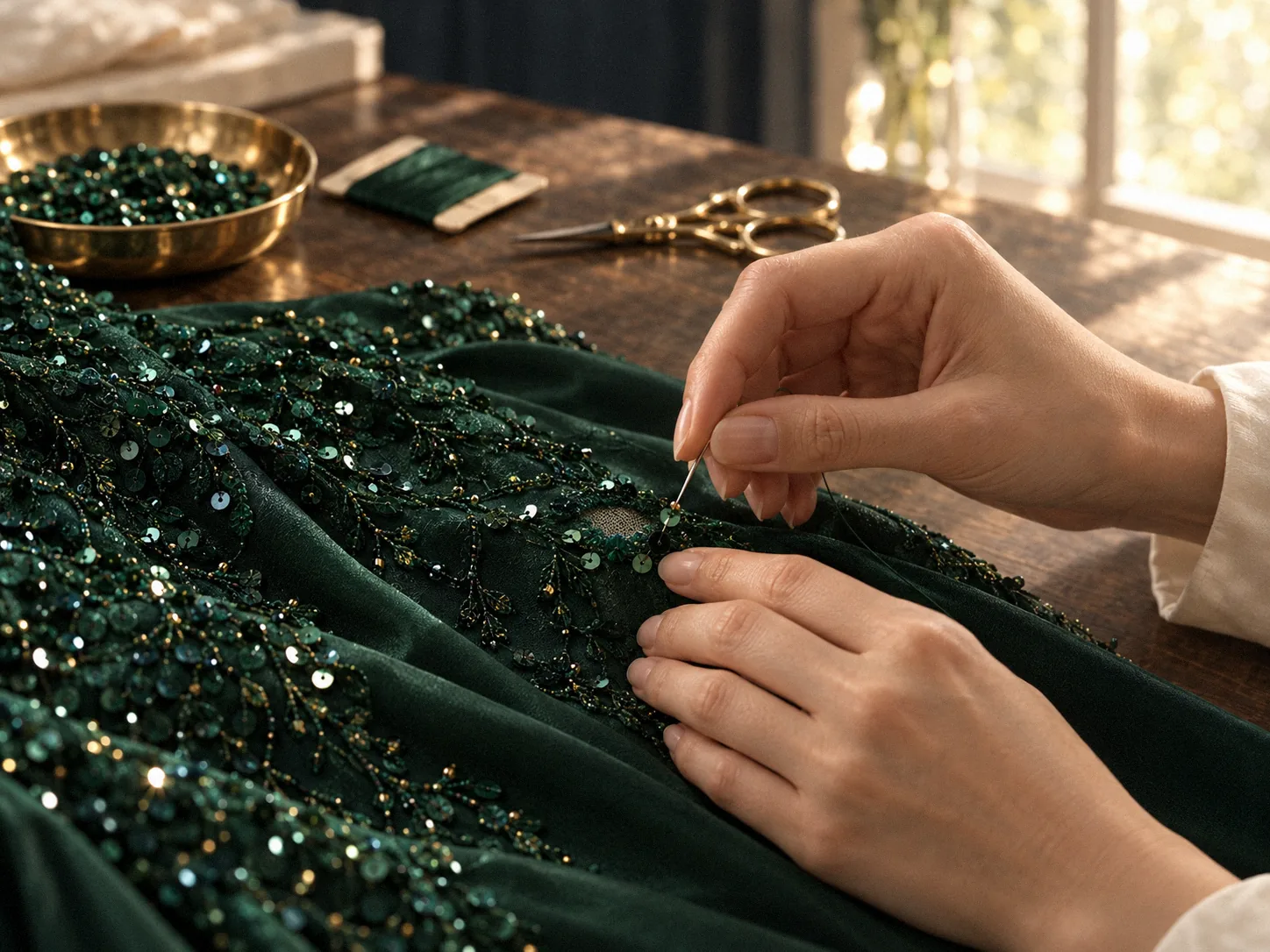
A case: a section lost at the side of the waist
A deep green silk gown, hand-sewn sequins and embroidery all over. After a few wearings the side of the waist had rubbed against a chair back; a palm-sized area of sequins was gone and the silk beneath had pilled. She asked: can it be rebuilt, and will it end up looking like an obvious patch?
Both answers lay in the gown itself. So the first thing I did was not look for sequins. It was to read the dress.
Rebuilding is not putting something new on top. It is learning the original's language and using it to say the missing passage again.
Reading the original: material, stitch path, base
Whether sequins are glass, plastic or metal decides how they catch light and how much they weigh. These were glass: heavy, with a hard, bright reflection. The stitch was a continuous backstitch through the centre hole, each sequin overlapping the last by about a third, running diagonally upward from the waist towards the bust. The base was silk twill, with a thin layer of organza beneath as support.
Every later decision rested on these facts. The wrong material and the light is different; a slightly wider spacing and the density is different; a shifted direction and a visible “border” appears under the lights.
Salvage: use the original sequins first
The sequins closest to the original are always the gown's own. I checked the inside of the hem and found a run of sequins sewn onto the turned edge where they would never be seen. With the client's agreement, I removed about sixty from there, cleaned and sorted each one, and set them aside for the waist. The hem was then made good with the nearest match.
Only the shortfall was sourced. Matching sequins is not a matter of colour cards: several candidates are sewn onto a scrap of the same green silk, set beside the gown, and compared under the window and under lamplight.
Piecing or re-embroidering
The damage sat at the side of the waist, a transitional passage rather than the central motif. That suits piecing: the pilled silk was first groomed, a fresh layer of organza added inside to spread the strain, then the sequins were sewn back one by one in the original direction and overlap, “growing” inward from the intact edge towards the centre so that no straight line divided old from new.
Had the damage been in the central motif at the bust, I would have chosen to re-embroider: remove the whole flower's sequins and threads, re-lay the design and work it again to the original. It takes far longer, but at the point where every eye lands, it is the only method that guarantees continuity and durability.
The sample comes first
Before beginning, I made a sample about three centimetres square on a scrap of the same silk: same sequins, same spacing, same direction. I set it beside the damaged area and asked the client to look once in daylight and once under lamplight. Only when she agreed did I start. It seems an extra step; it is the most important insurance in the whole rebuild.
Where the studio draws the line
If the base cloth has grown brittle, the thread has failed throughout, or the original sequin material can no longer be obtained, a local rebuild may need to become a wider reinforcement or a redesign. All of this is judged only after examining the cloth and stitching in person. We set out the options and limits together at the assessment.