Why it cannot all be done in one go
Many people imagine the fitting is an inspection and the alteration happens between fittings. It is the other way round: the fitting is part of the alteration, and the most important part.
Every part of a gown pulls on every other. Tighten the waist and the bodice rides up; shorten the straps and the neckline changes its curve; alter the hem and the balance of the train shifts. Pin everything at once and sew it all, and one misjudgement means unpicking the whole gown. Staged, we change one layer at a time, then let the body tell us about the next.
Staging is not slowness. It cuts the risk into pieces small enough that every step can be undone.
The first fitting: set the frame, not the decoration
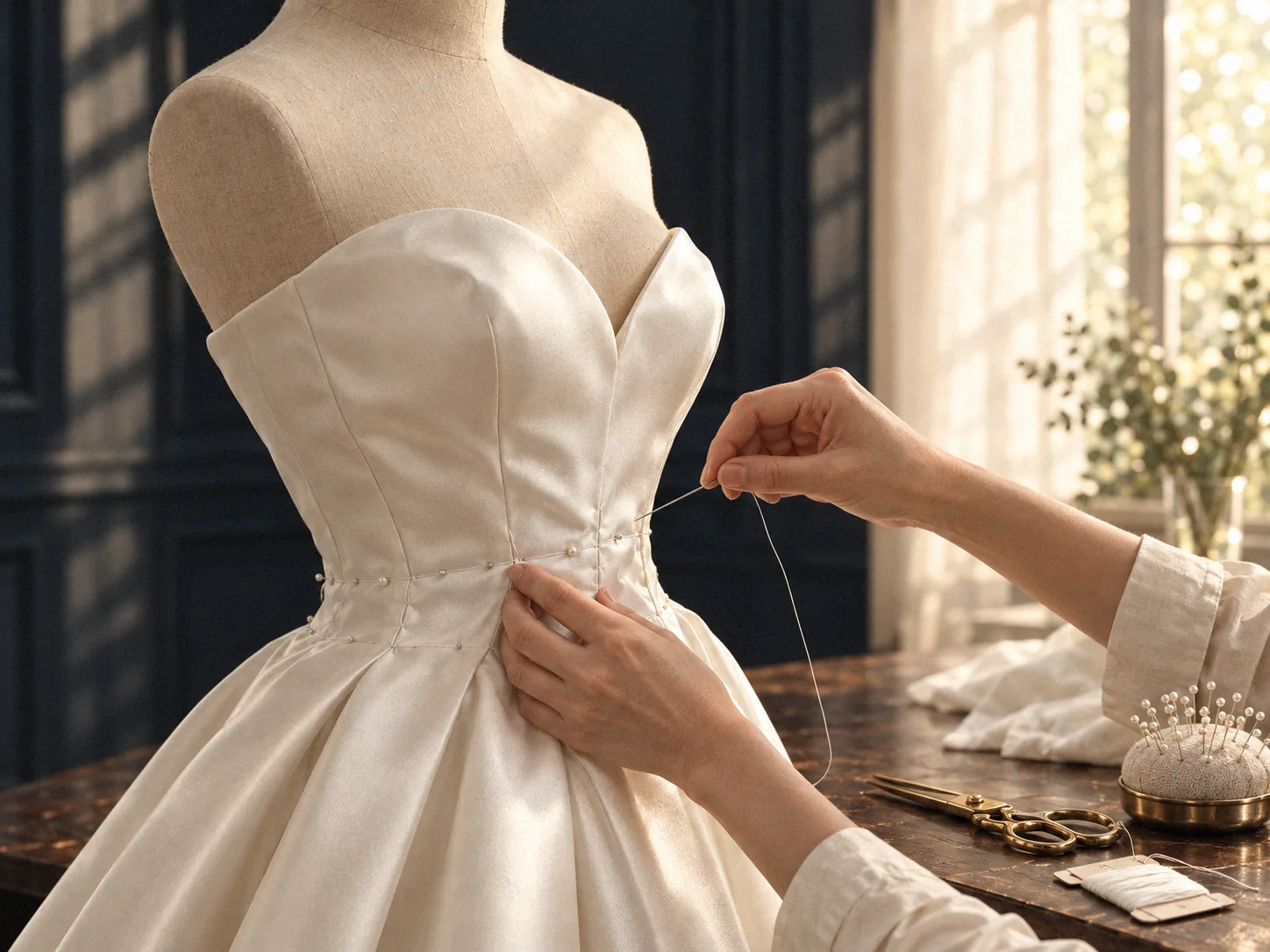
At the first fitting I look at three things only: hem length, shoulder line, waist position. These are the gown's frame. I fix them temporarily with tacking or pins; nothing is sewn permanently and the beads and lace are left alone.
This is also when the lining and support are judged: is the boning strong enough, are the cups in the right place, does the petticoat suit this bride's stride? If the lining has to be remade, it must be decided now, because it changes every measurement that follows.
The bride leaves with a gown full of tacking, chalk marks and a list. It looks unfinished, and that is exactly how this stage should look.
The half-finished fitting: proportion and movement
Once the main structure is sewn, the second fitting looks at the proportion of details: whether the bust is full without pressing, where the sleeve ends on the wrist, how high the slit sits to be both graceful and walkable, how the bustled train falls.
Then movement. Sit, stand, raise the arms for an embrace, turn, walk a few steps, take a stair. If there is a toast, raise a glass; if there is a first dance, dance a little. The comfort of every seam shows only in motion. Local changes are still possible at this stage, so finding a problem is not a failure; it is the point.
The final fitting: refine and secure
With all decoration in place, the final fitting is for refinement only: half a centimetre, one bead, one line of stitching. Then everything is secured: seams reinforced, hooks checked, the bustle fastened and unfastened several times. I ask the bride to walk once more and sit once more, to confirm that everything is still right in its finished state.
If a structural issue appears at this fitting, I pause rather than improvise on the spot. One more fitting is always better than a hidden fault at the final step.
When three is not enough
Three is the usual rhythm, not a rule. Extensive hand beading, a lining to remake, a bride whose weight changes meaningfully in the interval, or a gown from abroad needing substantial reduction may all call for four or more. I give an estimate at the first assessment and update it after each fitting.
Where the studio draws the line
Gowns with extensive hand beading or a lining to remake may genuinely need more than three fittings. The final number depends on the garment and the time available. We do not merge two stages to save a fitting.