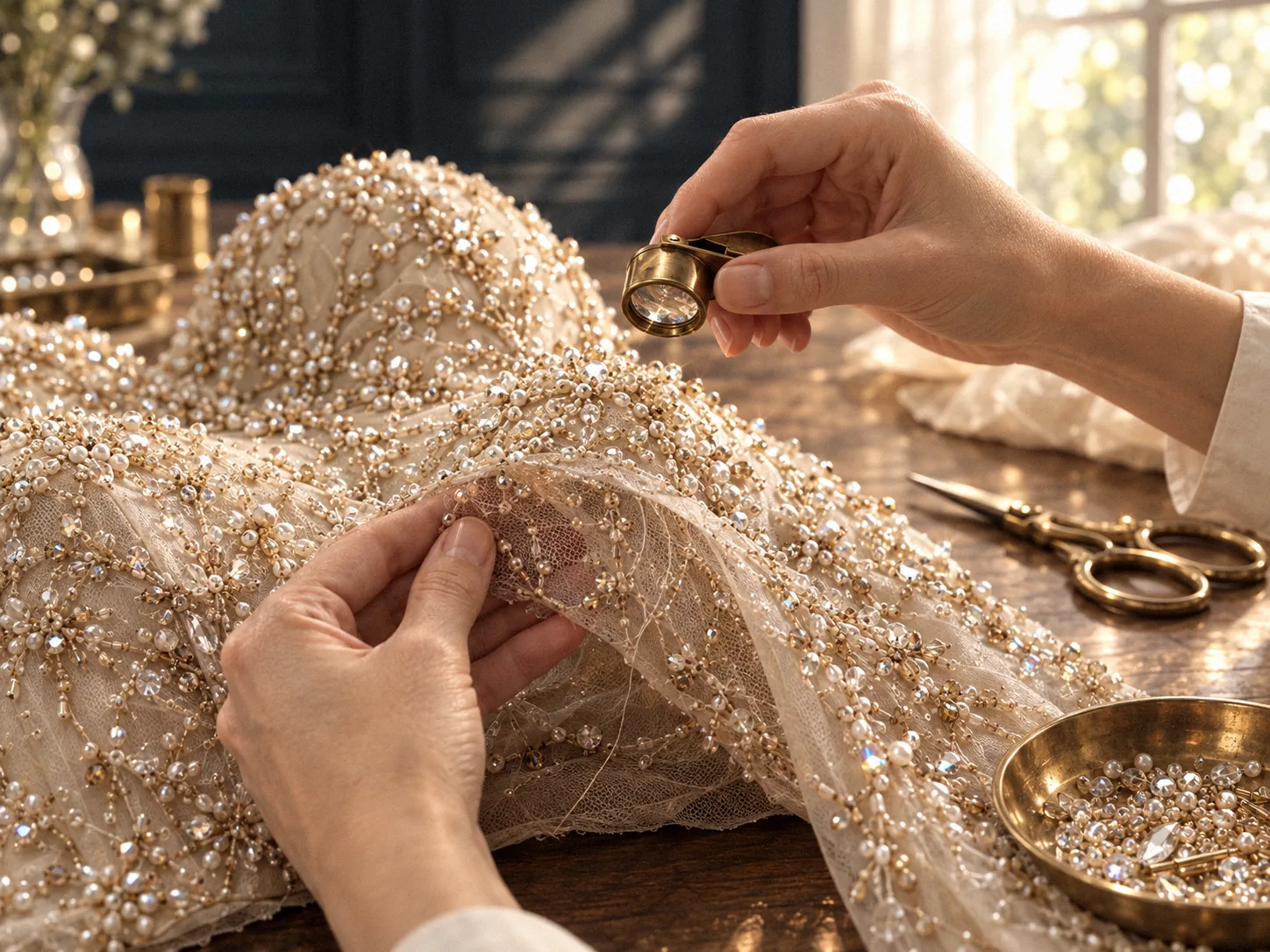
The first question: which layer holds the beads
With a beaded gown, I turn it inside out first. The inside is far more honest than the outside.
On some gowns the beads are sewn straight onto tulle or chiffon, each thread passing through that whisper-thin cloth. Remove one bead and you leave a hole; remove a row and the weave may run. On others the beads sit on a base or net layer that is then mounted onto the face fabric. These gowns give us far more room, because we can work between the face and the base without touching the beads themselves.
Both are “beaded gowns”, yet the two constructions call for entirely different logic. Until this is clear, nothing should begin.
The second question: which way the beads run
The distribution decides which seams may be touched. If the beads gather at the bust or hem and the side seams and waist are relatively clear, taking in the waist or sides is straightforward. But if beads run continuously along the side seam, the waist or the princess line, any change on those lines pulls the passage apart: one side of the motif moves two centimetres inward, the other does not, and the pattern no longer meets.
Then there are three options: find another place to make the change where there are no beads, such as the centre back; remove the beads over the affected area, adjust the base cloth and re-bead; or introduce a compatible panel to cover the join. Each differs in time and risk, and each is explained at the assessment.
The third question: can the cloth beneath carry the beads
Beads have weight. On a densely beaded gown, the beads can weigh several times more than the cloth itself, and all of it hangs from the stitches and the base. Before any change, I check whether the base has stretched, whether the stitches have tired, and whether the lining and the beaded layer still hang together.
Taking in a beaded gown often means reinforcing the lining at the same time; otherwise, once the gown is tighter and the weight shifts, the beaded layer sags or drags on the face fabric. It is the step most often overlooked.
The studio's order: inside first, beads last
Removing and re-applying beads can be done, but it is the last resort, not the first. Every removal leaves a trace in the cloth and uses up original beads and thread.
So I ask first: can an inner seam in the lining take up the excess inside? Can a narrow elastic at the inside of the waist do the work? Can adjusting the strap length let the bodice settle naturally? Very often these surface-free methods solve most of the problem.
Only the remainder justifies touching the beads. Before that, I photograph the direction and density of the work, bag the removed beads by position, and once the base is adjusted, sew them back one by one in the original rhythm. Missing beads are replaced in the nearest colour and size.
When I would say “not advisable”
Beads sewn onto a single layer of very fine tulle, no spare fabric, and a change that must run along a densely beaded line. When these three coincide, the risk of removal very likely outweighs the benefit. I would suggest leaving the gown as it is, or approaching from another side: changing how the lining is worn, or the styling, rather than the beaded layer.
Where the studio draws the line
Where beads are sewn into tulle or dense embroidery with no spare cloth, an in-person examination is needed before any change, to weigh the risk of removal and the remedies available. Photographs cannot show how taut the base is, the state of the stitches or the relationship between the beaded layer and the lining.