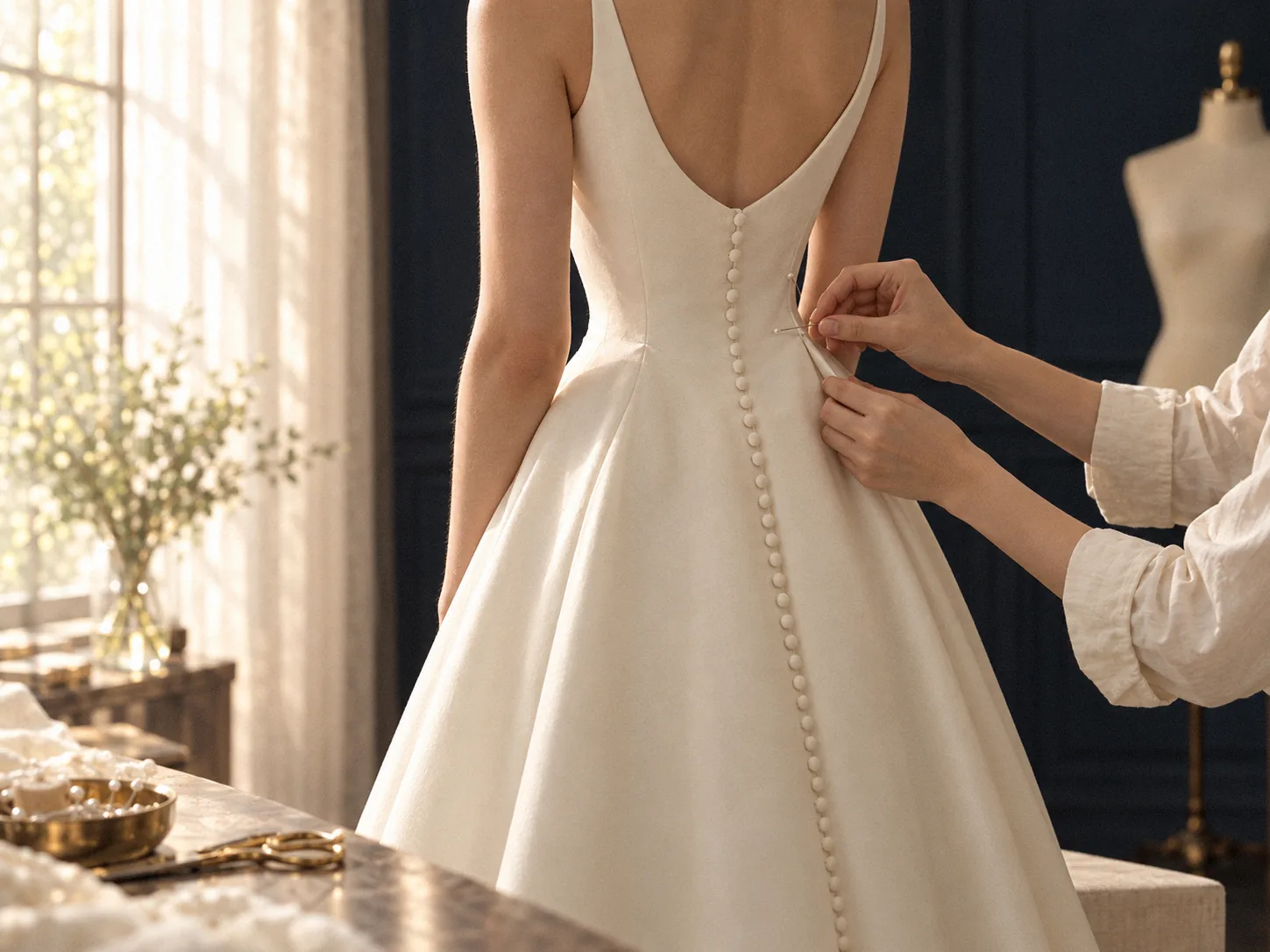
Why so early
Every year a few brides arrive two weeks before the wedding, gown in hand, and ask politely: “Is there still time?”
Usually the answer is yes, but the price is that we can make only one decision, with no second fitting to correct it. A wedding gown is built on the body: straps bear weight, the bodice supports, the waist anchors, the skirt moves with every step. After the first round, the body tells you what is still not right, and that message needs time to be answered.
Three to six months is not because the work is slow. It is because a good fit is a conversation, and a conversation needs replies.
Three to six months out: the first assessment
At the first meeting I do not rush to measure. I look at the gown first: whether it is silk, satin, chiffon or lace; whether the inside has boning, cups, a double layer of interfacing; whether the beads are sewn to the face fabric or to a base layer; how the train is attached. These decide which changes are simple and which require opening the gown.
Only then do I see it on you. I note three things: what needs changing, the order in which the changes must happen, and roughly how many fittings it will take. You leave with a clear list, not a vague “it should be fine”.
How many fittings: two, three or four
Light work, such as shortening the hem, taking in the waist a little or adjusting the straps, usually needs two fittings: one to pin, one to confirm.
For a new bust shape, re-boning, changes to the train or re-laying beadwork, I plan three or four. These changes affect one another: tighten the bodice and the load on the straps shifts; shorten the train and the skirt's balance moves. At each fitting we settle one layer, then let the body tell us how the next should go.
After each fitting I record item by item what was changed, what was measured and what must be confirmed next time. That record travels with the gown until the day it is collected.
The most important fitting: in the real shoes
The hem can only be set with you in the shoes you will wear on the day. A centimetre of heel is the difference between a skirt that sweeps the floor and one that floats above it. Likewise, your underpinnings, jewellery and the height of your hair all change how the neckline and shoulders read.
So bring all of it to that key fitting. We walk, turn, sit and raise the arms; if there will be dancing, we dance a little. The comfort and strength of every seam is tested in movement, not in front of the mirror.
The final week before collection
After the last fitting the gown goes into finishing: decoration secured, seams reinforced, lining settled, the whole gown steamed. I keep that week deliberately clear of new changes. Last-minute alterations are the ones most likely to go wrong.
If the gown was bought abroad, has to be sent back, or must travel to another city before the wedding, count those days in as well.
Where the studio draws the line
If a gown carries dense hand embroidery, needs structural rebuilding or extensive re-beading, the real time and number of fittings can only be confirmed after an in-person assessment. We tell you honestly at the first meeting how long it will take; if the time truly is not there, we propose keeping the gown as it is, or completing the work in stages.