Four different things are all called “waterproof”
When a client brings in a “waterproof jacket”, my first move is not to look at the tear but to turn the lining and look at the seams.
There are at least four kinds of waterproof fabric. The first is a PU coating: a layer of polyurethane applied to the back of the base cloth, slightly rubbery to the touch. The second is a laminated membrane: a very thin waterproof-breathable film sandwiched between face and lining, with seams sealed by heat-applied tape. The third is a DWR finish: the cloth itself is not waterproof, but a repellent on the surface makes water bead and roll off. The fourth is traditional waxed cotton: cotton impregnated with wax, which can be re-proofed.
Four fabrics, four repair logics. Mistake one for another and the function will not come back.
Why it cannot simply be stitched
An ordinary garment can be stitched. A coated fabric cannot, or at least not only stitched. Every needle hole through the coating or membrane is a point where rain will follow the thread inside. The factory method seals a strip of waterproof tape over the back of every seam to close those holes. In the studio, if the damage is in the membrane, I avoid stitching through it and close the tear with a heat-bonded patch instead; if stitching is unavoidable, the seam is re-taped on the inside afterwards.
Heat bonding has its own temperature and timing, and different coatings tolerate different heat. This is another reason we must identify the coating first: too hot and the membrane melts or blisters; too cool and the patch will not hold.
Around seams and zips: trading waterproofing for breathability
The most common failures are not in the middle of a panel but at seams that have opened, tape that has peeled, and zip edges that let water in. Repairing these requires you to tell me first what matters most to you.
Re-taping restores waterproofing, but tape does not breathe, so the area will be warmer than before. If the seam was originally heat-welded, stitching it and then taping makes it stiffer and thicker. If your jacket is worn in town and meets the occasional shower, I would keep as much of the original membrane as possible and repair locally. If it is genuinely for the hills, function comes first: a professional heat-bond and adhesive process, with a frank note that the repaired area will breathe a little less than the factory original.
Waxed cotton: it can be stitched, then re-waxed
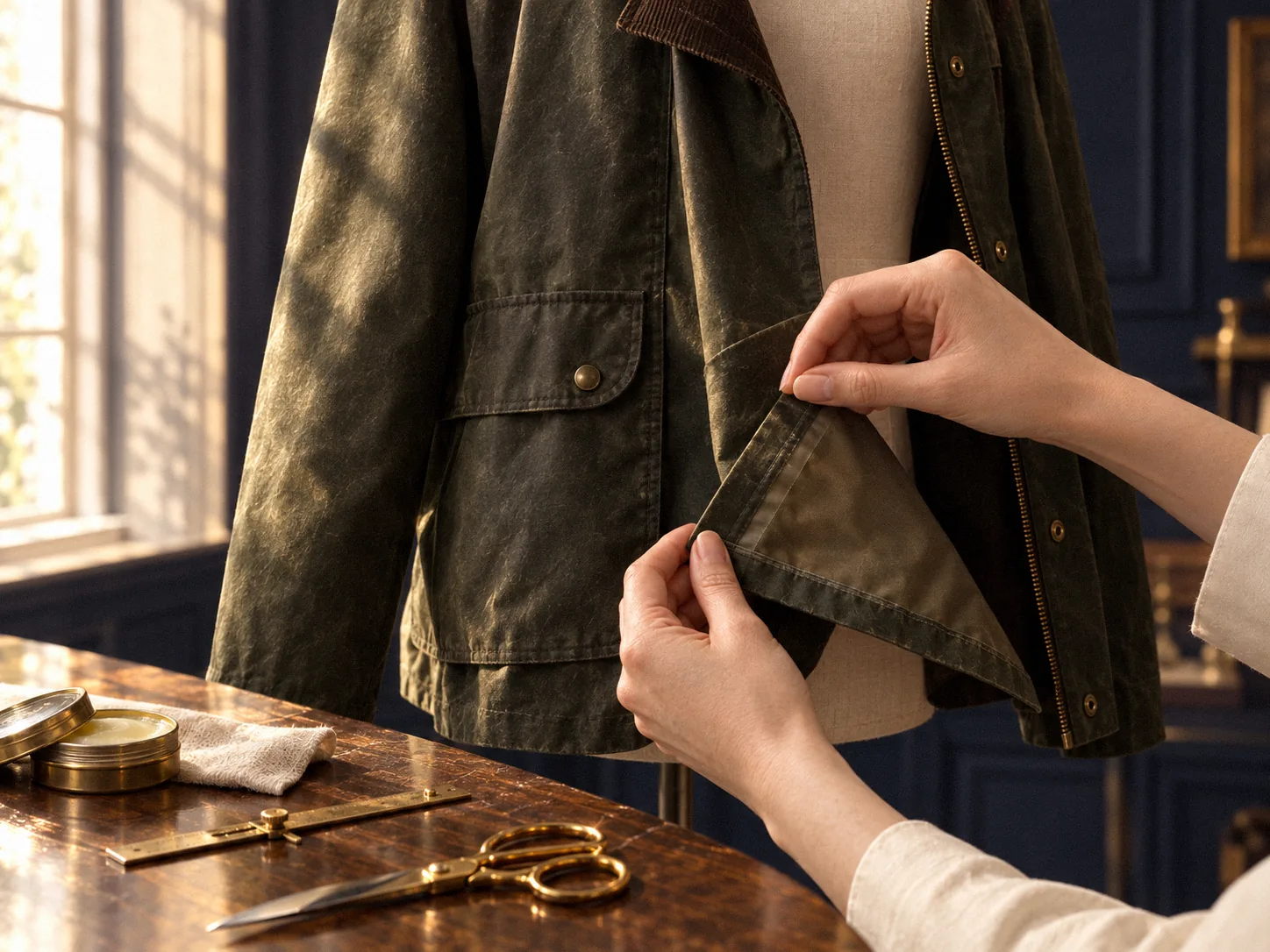
Waxed cotton is the most forgiving of the four. Its waterproofing comes from the wax, not a membrane, so a tear can be hand-patched with a similar waxed cloth and the whole area re-waxed, filling the needle holes. Over years the wax dries, whitens and creases; the whole jacket can be re-proofed and the cloth returns to its deep colour and sheen.
Waxed cotton has one limit: it cannot be dry-cleaned or washed in the ordinary way without losing its wax. Please do not have it cleaned before bringing it in for repair.
DWR jackets: the problem is usually not a tear but “it no longer beads”
Many clients believe a jacket “is no longer waterproof” when in fact the surface repellent has worn off or been masked by dirt. This is not a repair but care: a thorough clean, then re-treatment with a purpose-made repellent. At the assessment we distinguish a care issue from a structural one, so that you do not pay for a repair that is not needed.
Where the studio draws the line
We need to examine the coating, the damage and the construction in person, because the coating and membrane decide both what can be done and how much function returns. A local repair restores most of it, but we will not call it equal to the factory original. If, after assessment, a repair cannot give you the function you need, we will say so.