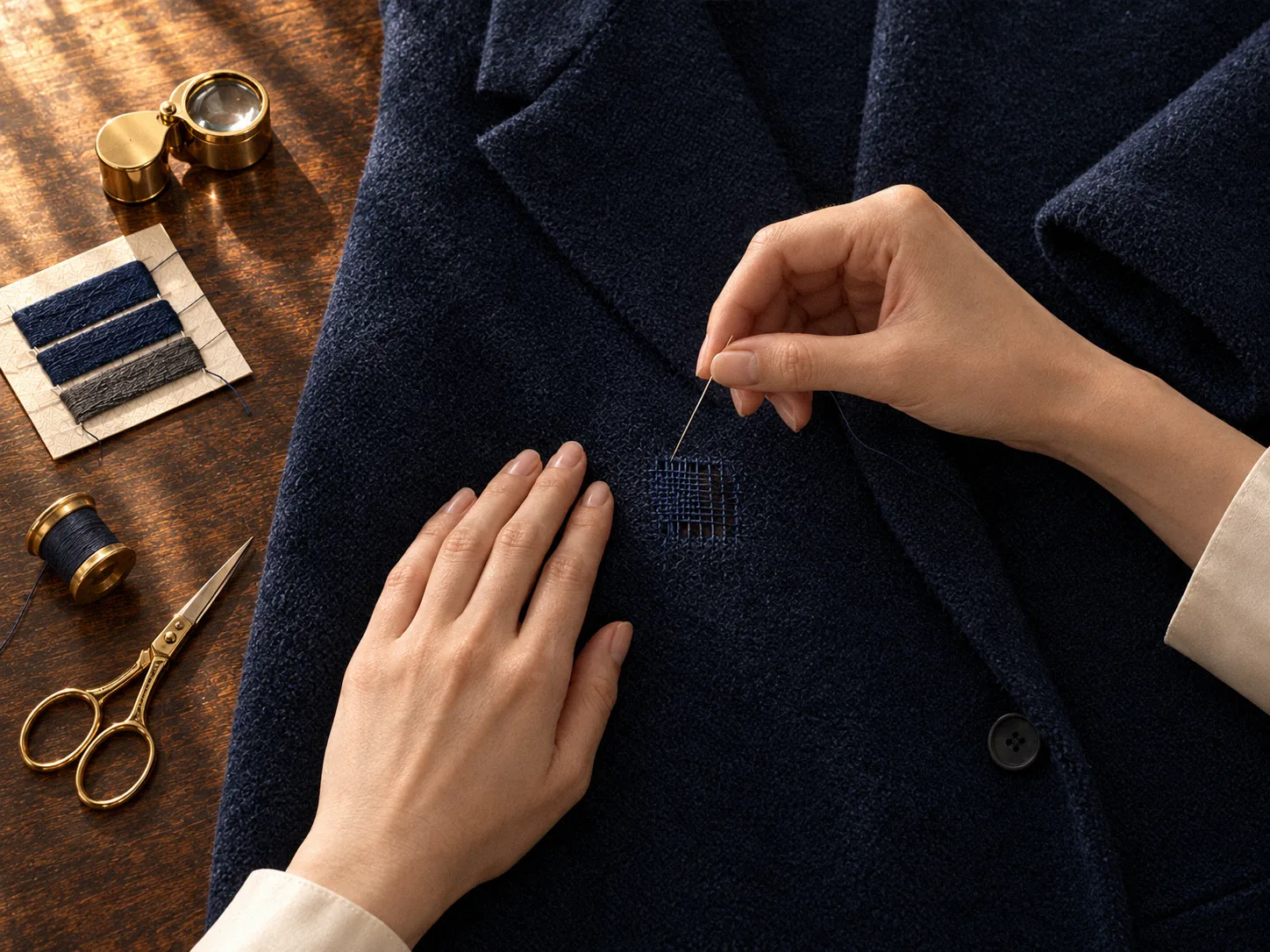
Damage is never a point; it is a chapter
When a client brings in a coat, a silk blouse or a wool knit, she usually points first at the hole, the burst seam or the fallen button and asks: “Can this be fixed?”
I understand the question. But I never look only at that spot.
The place where a garment fails is usually only its first signal. A worn cuff may mean the fibres around the whole elbow are tiring. A split lining may mean the outer and inner layers no longer hang together. A loose button may be telling us that the buttonhole, the front edge and the interfacing beneath have all been pulled too many times.
Real repair reads the garment as a whole. It does not cover the problem; it first understands why it happened here.
First judgement: does this fabric still have strength?
Not every garment should be stitched straight away.
Wool, cashmere, silk, tweed, fine cotton and older blends each age in their own way. Some have a local fault with stable fibre around it. Others show only a small hole, but the cloth has thinned, dried or lost its resilience, and one more line of stitching would simply carry the strain next door and widen the damage.
So I check by hand, in daylight and under magnification: does the fibre still spring back? Has the colour shifted from sun or cleaning? Are the inner and outer layers in the same condition? Photographs rarely tell us all of this.
Faster is not better. Finding out how much the cloth can bear is the real respect a garment deserves.
Second judgement: is the damage on a structural line?
Some parts of a garment are quiet. Others take strain every day.
Underarms, elbows, the crotch, side seams, the base of a zip, pocket corners and button positions are all under constant pull. If the damage sits on one of these lines, a smooth surface is not enough; the load has to be redistributed first.
A burst side seam sometimes needs more than restitching; it needs the seam allowance, lining and surrounding cloth checked for support. A coat's shoulder, collar or front edge may involve canvas and three-dimensional structure. Repair it too stiffly and the garment loses its softness; too lightly and it will not last.
The difficulty of fine repair is exactly this balance between looking natural and wearing reliably.
Third judgement: if the original fabric cannot be found, is there still an honest option?
Many people assume a repair is pointless unless the identical fabric can be found.
Of course, original spare cloth or a matching material is the ideal. But many garments are long out of production, fabric fades, and old cloth may no longer take new strain. The question then is no longer “can it be identical?” but “what comes closest to this garment's original character?”
I look at tone, not just colour; at texture, not just weight; at sheen, drape and hand, and whether it suddenly looks foreign in the light. Sometimes the best patch is not perfectly invisible but quietly in conversation with the original. It does not shout, and it does not pretend not to be there.
This is also why I love handwork. It lets us go slowly enough to find a garment its truly right answer.
Fourth judgement: discreet repair, or a visible one?
“Will it show?” is what most clients care about.
I understand. For a classic coat, a garment for an important occasion or a very fine cloth, discretion is usually right. But not every repair needs to be erased. Some garments carry a story that deserves to be kept gently. On heirloom pieces, hand knits, older weaves or fabric with particular memories, a measured line of darning or a careful patch can become part of the garment's life.
The point is not visible versus invisible, but whether the trace of repair is in keeping with the garment's character. It can be quiet or candid; it should never be crude, and never a pretence.
Fifth judgement: once repaired, does it still suit your life now?
Repair is not the end.
Once a garment is mended, we still ask: how will you wear it? Should it be hung or stored differently? Should some cleaning methods be avoided? Is it still right for frequent wear, or better kept for particular occasions?
Some pieces return to everyday life. Others are better worn less often and kept well. The studio's work is not only to make a garment wearable again, but to help its owner understand how to extend its next life.
We do not call repair magic
Some garments are already too fragile. Some fabrics are worn over a far larger area than the surface shows. Some designs cannot be opened without adding risk. In these cases we say what can be done, what cannot, and whether a more conservative path exists.
Saying this plainly does not take hope away. It lets a client make a decision about a treasured garment with real peace of mind.