The real damage is not the hole
Every year, as spring turns to summer, the studio receives wool coats, cashmere sweaters and suit trousers brought out from the back of a wardrobe. The client points at a few pinhead-sized holes and asks: “Can these be closed?”
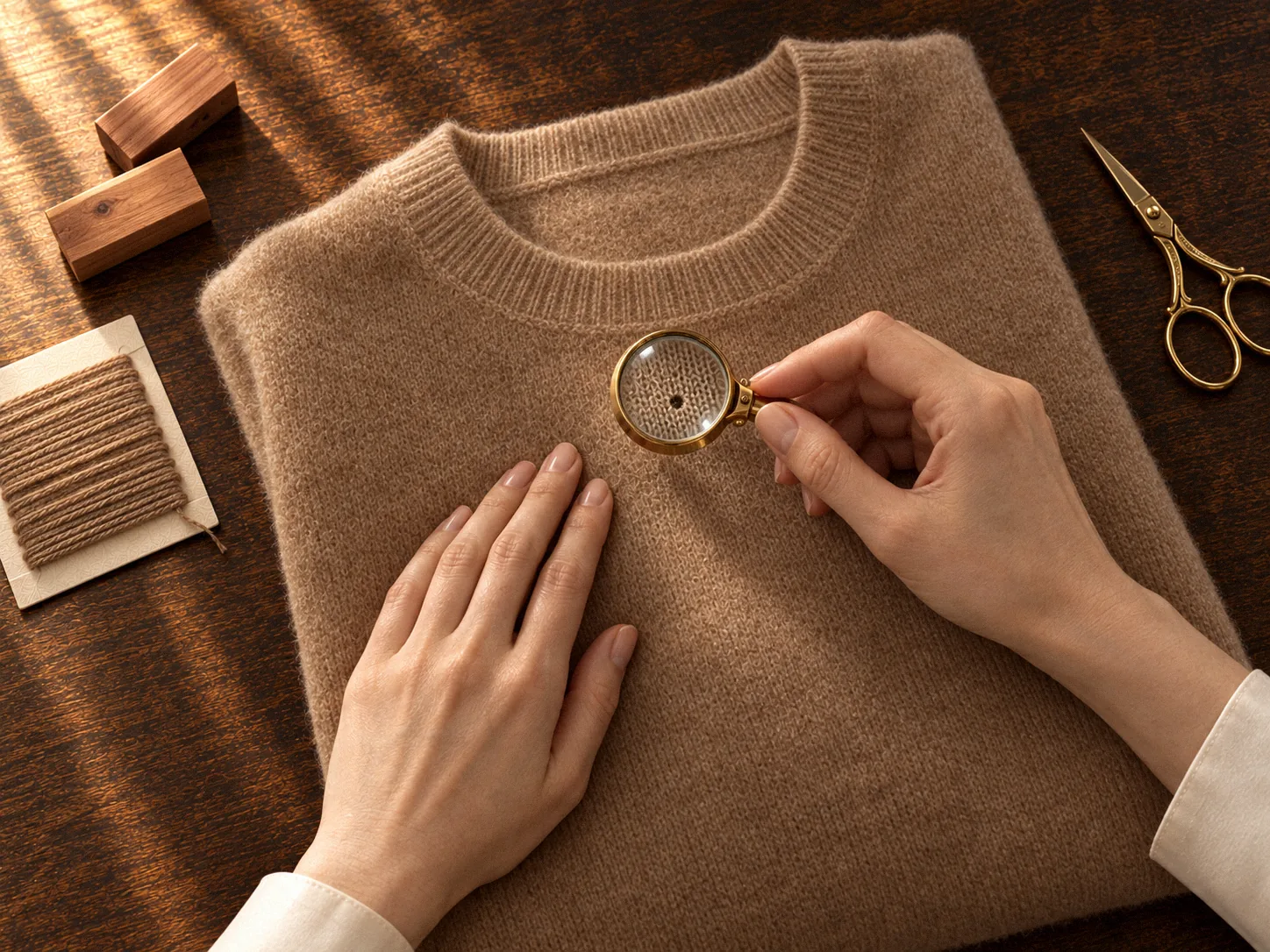
I do not answer at once. I lay the garment flat on the table in the daylight from the window. Moth larvae do not simply bite one hole; they graze across the fibre surface, leaving a thinned area far larger than the hole and not always visible to the eye. The hole is only where they broke through. The ring of weakened, sparse fibre around it is what the repair really has to face.
Closing a hole is easy. Closing it without the cloth beside it failing is the craft.
Three checks: light, hand, lens
First, light. Held up against the window, thinned areas show brighter than their surroundings; this step often finds a second and third hole the client has not noticed. Second, hand. Brushed gently, healthy wool springs back; damaged fibre feels dry, limp and slack. Third, the loupe. We read the construction: plain or rib, the size of the loop, the ply of the yarn, and whether eggs or silky residue remain inside.
Only after these three steps do I know whether we are dealing with “a hole” or “an area”. The method, the time and the outcome differ entirely.
Reweaving: for small, isolated holes
If the hole is small and the fibre around it still sound, reweaving comes closest to “as it was”. We find a yarn of similar weight, twist and colour, sometimes drawn from the garment's own inside seam allowance, and follow the original stitch gauge, row by row, to rebuild what is missing.
It is slow work. A coin-sized hole can take hours. Done well, the hand and drape match the surrounding knit, without the extra layer a patch adds. This is why it suits cashmere: its lightness and softness will not tolerate any added weight.
Patching and colour finishing: when the hole has spread
When a hole is larger than a fingernail, or the cloth around it has thinned, reweaving alone concentrates the strain on the new yarn and it soon opens again. Here I place a light backing on the inside to spread the load first, then finish the surface with matched stitching so the eye reads it as continuous.
The backing must suit the outer cloth: wool with wool, cashmere with a featherweight cashmere or silk-cotton. Too heavy and the piece wears with a stiff patch; too light and it does not hold. These are decisions made on the garment, not in advance.
When to stop
Some wool garments are grazed across the whole front, or the holes fall exactly on the shoulder line, the armhole or the pocket corner, where strain is constant. Even with every hole closed, the structure remains weak. Spending more hours reweaving would be a disservice to your time and to the garment.
I say so plainly. Then we look at a second path together: replacing the damaged panel, shortening a sweater into a gilet, recutting the front of a coat into another garment. This is not giving up; it is letting good wool stay with you in another form.
Once repaired, keep them away
After a moth repair the garment should be cleaned so that no eggs remain. Store it in a breathable cotton bag, not plastic. Cedar or lavender in the wardrobe helps a little; what truly works is a clean, dry garment taken out to air regularly. What wool fears most is not the moth but being forgotten.
Where the studio draws the line
If wool fibre has weakened over a wide area, or holes reach the critical parts of a panel, only an in-person examination can confirm whether reweaving, patching or panel replacement is right. Photographs give a first impression; they cannot replace light, hand and lens.