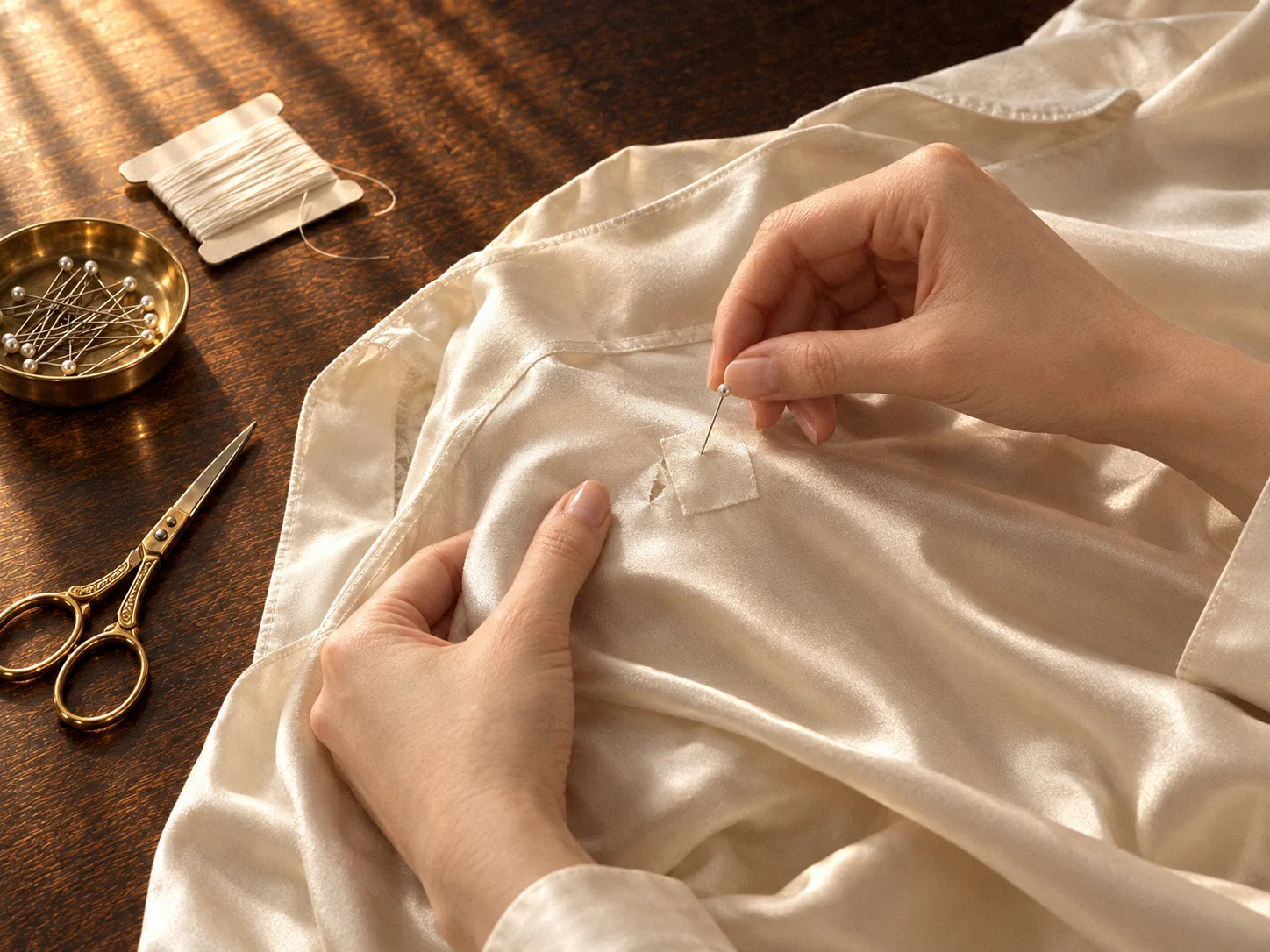
The first decision about a patch is where
Most people assume the difficulty of a patch lies in the stitching. The most important decision is made before the needle is picked up: where the join will sit.
A garment has many natural hiding places: darts, side seams, pocket edges, the waistline, the armhole, the turn of a front edge, the fold of a hem. A line already exists there and the eye is used to seeing a change at that point. Set the edge of a patch on one of these lines and the strain is carried by the existing seam allowance while the eye slides past.
This is why our patches are often much larger than the hole itself: not to mend more, but to push the border onto a line that was already there.
The second decision: grain
Fabric has direction. The angle of a twill, the repeat of a check, the light direction of a satin, the pile of a velvet: all of these are direction. Cut the patch even slightly off and it shows at once under light: one side bright, one side dull, a check that does not meet.
So I chalk the warp and weft on the new cloth first, lay it against the grain of the original, pin it, and step back two paces to look from several angles. Only when the direction is certainly right do I cut. After cutting there is no way back.
The third decision: where the material comes from
Material follows a clear order of preference. First, the garment's own spare cloth, including any swatch supplied by the brand. Second, cloth borrowed from the garment itself: the inside facing, the turned hem, the pocket bag, cut from the same bolt and dye lot and aged alongside the outer cloth. Once borrowed, that area is made good with a compatible fabric. Only third comes outside cloth, matched by twist, sheen and density.
Borrowing from the garment sounds like robbing one wall to mend another, but for a fine fabric it is often the most honest and the most invisible solution, provided the borrowed area is not structural and you have agreed to it first.
Method: in layers, not one pass
On fine fabric I rarely use a machine. Hand stitching controls the pull of every stitch; a machine needle drags the cloth and leaves punctures that cannot be undone.
The order is inside to out. First a featherweight interfacing or support net goes on the inside, spreading the strain around the damage over a wider area. Then the patch is set in place and fixed with slip or ladder stitches along the structural line, with stitches falling into the existing seam wherever possible. Finally, if the colour is still a touch off, the border is graded. Each layer has its job; remove one and the whole is unstable.
Why a test repair always comes first
Even with placement, grain and material all right, I still make a trial on a small inconspicuous area first. The fabric's true response is only known once it is sewn: whether it puckers, whether the extra layer shows through, whether it shrinks differently after cleaning.
Once the trial is done I photograph it for you and explain how visible it is and where the limits lie. Only with your agreement do we proceed to the full repair. That is the studio's process, and the respect a fine garment is owed.
Where the studio draws the line
Differences in sheen and twist on fine fabric are tiny but magnified by light. The availability of material and the result of the test repair decide what can finally be done. We do not promise an outcome before the trial, and we do not begin without a source of suitable cloth.