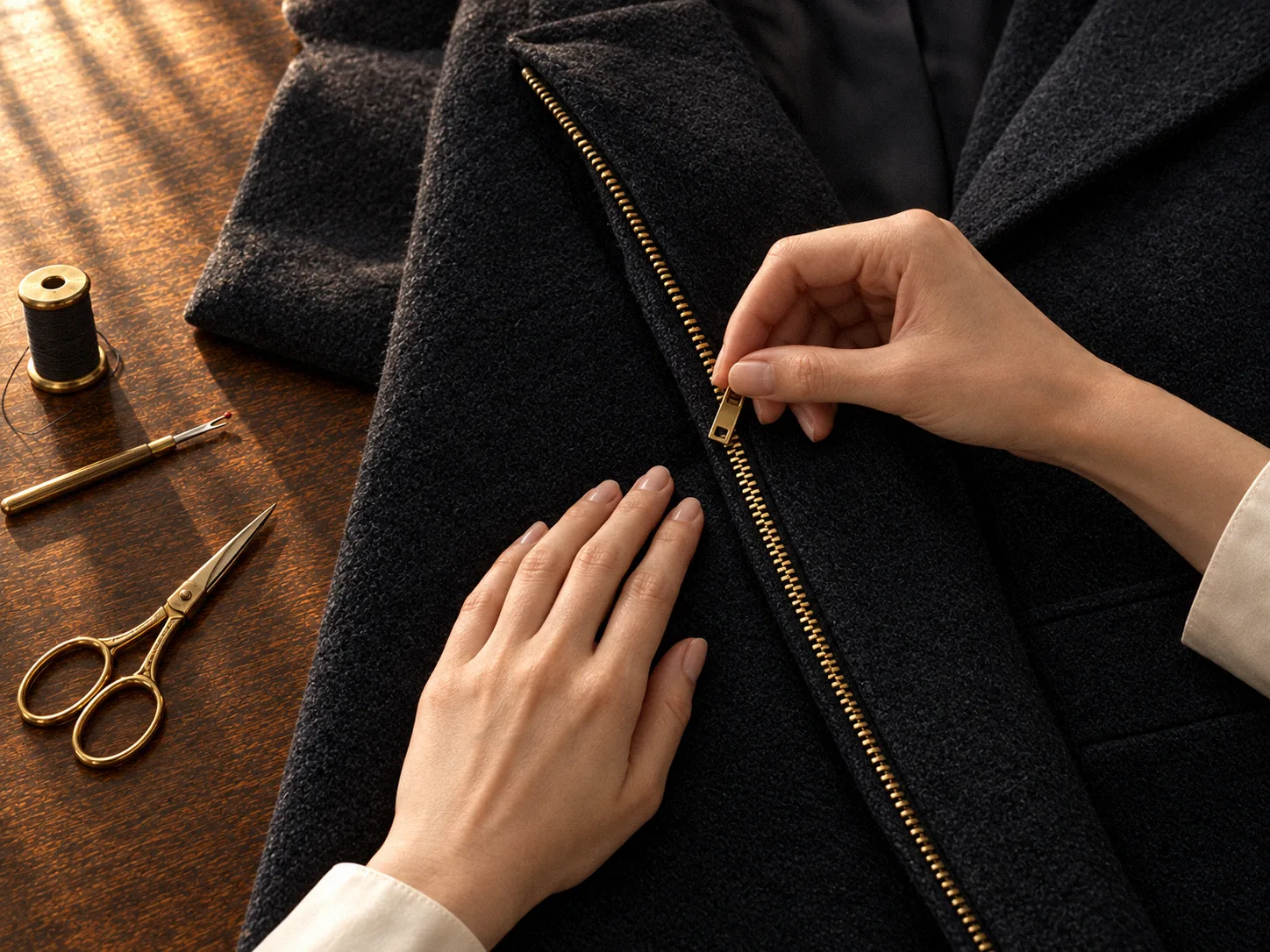
First, which part has failed?
A client usually arrives with one sentence: “The zip is broken.” On the worktable, that sentence can mean three quite different things.
The first is a failing slider: it has spread, worn, no longer closes the teeth or jams halfway. The teeth themselves are fine; only the small part that locks the two rows together has loosened. The second is damaged teeth: one or two missing, bent, or a bottom stop that has come away. The third is the tape itself torn or frayed, pulled away from the stitching, sometimes taking the cloth beside it.
Three faults, three different procedures. Only when we know which one it is can we say “this can be repaired”.
A loose slider: the most common, and the most over-treated
Many zips that will not close simply have a loose slider. After years of use the two wings of a metal slider spread apart, lose their grip, and the teeth no longer lock. This does not call for a new zip. With a slider of the same gauge and tooth type, we remove the top stop, fit the new slider and replace the stop, and the zip works again.
The difficulty is matching. On designer pieces the zip is often made to the brand's specification: an engraved pull, a particular polish or plating. We try to source the same maker and series; failing that, we discuss with you whether to keep the original pull on a new slider body, or accept a slider that is close in form but not original. That is an honest choice, not a compromise.
Missing teeth and worn tape: usually a full replacement
A single missing tooth looks minor, but the slider will catch, skip or damage its neighbours every time it passes. Replacing one tooth is not a reliable repair, so missing teeth almost always mean a new zip. A frayed tape is the same: once the weave has weakened, however carefully it is re-sewn, the point of strain will tear again.
When we replace the whole zip, I match the tooth profile, gauge, metal finish and tape colour as closely as possible. An invisible zip is replaced with an invisible zip; metal teeth with the same gauge of metal teeth. The feel of a zip is part of putting the garment on; too stiff or too slack is wrong either way.
The real question: can the cloth beside the zip still take it?
Replacing a zip is not hard in itself. The hard part is that a zip is sewn into a garment, and the seam that holds it often tires before the zip does.
The zip at the centre back of a skirt, the fly of a pair of trousers, the front of a jacket: every closing sends strain into the seam allowance beside it. If that allowance has been perforated by earlier stitching, worn thin at the edge or was cut narrow to begin with, a new zip will soon tear away again. So in assessing, I open a short section first to see how much allowance remains, whether the lining has fused or grown brittle, and how the original stitching runs.
If there is not enough allowance, there are options: a narrow facing to reinforce the edge, re-finishing the edge of the panel, or, where the design permits, moving the zip position slightly. All are possible, but they need to be agreed first, because they are no longer “replacing a zip”; they are rebuilding that seam.
Decorative tapes, facings and zips close to an edge
On fine outerwear the zip is rarely only functional. Some are bound in leather, some sit between ribbing or a decorative braid, some are the design itself. Replacing them means removing the trim, fitting the zip, and re-applying the trim exactly as it was made. Every layer adds a margin for error.
I count these layers at the assessment and tell you which can be restored exactly and which, once opened, may not return one hundred per cent to their original state. Only with that knowledge can you decide whether it is worth it.
Where the studio draws the line
If the cloth at the zip seam has worn thin, or the panel edge sits too close to the zip, no photograph can tell us whether a safe replacement is possible. We have to open it. After the assessment we set out in one go what can be done, what will be touched, and how the finished piece will differ, if at all.